Test Index
Electric Charges and Fields
Electric Charges and Fields

 CBSE Board Videos
© examsnet.com
Question : 7 of 29
Marks:
+1,
-0
Two point charges and are held '' distance apart in free space. A uniform electric field is applied in the region perpendicular to the line joining the two charges. Which one of the following angles will the direction of the net force acting on charge make with the line joining and ?
[CBSE 2025 55/4/3]
Solution:
Concept:Two forces act on and they are perpendicular to each other:1. Coulomb attraction towards , along the line joining the charges: 2. Force due to the field, perpendicular to that line (opposite to , as the charge is negative): 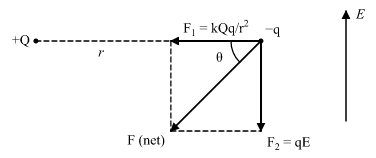 Solution:Let the net force make angle with the line joining and . ThenKey point: cancels. The angle is measured from the line joining the charges, so the force along that line () goes in the denominator; of the same ratio would be the angle with .Answer:Option A ()
© examsnet.com
Go to Question: