Test Index
Electric Charges and Fields
Electric Charges and Fields

 CBSE Board Videos
© examsnet.com
Question : 21 of 29
Marks:
+1,
-0
A beam of electrons moving horizontally with a velocity of m/s enters a region between two plates as shown in the figure. A suitable potential difference is applied across the plates such that the electron beam just strikes the edge of the lower plate.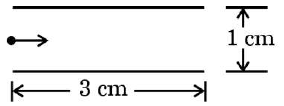 Answer the following questions based on the above :(a) How long does an electron take to strike the edge ? (1)(b) What is the shape of the path followed by the electron and why ? (1)(c) Find the potential difference applied. (2)OR(c) Find the magnitude and direction of the magnetic field which should be created in the space between the plates so that the electron beam goes straight undeviated. (2)
[CBSE 2023 55/3/1]
Solution:
Given: m/s, plate length cm m, plate separation cm m. The beam enters midway between the plates, so to strike the edge of the lower plate it is deflected by cm m.(a) Time to strike the edge:There is no force along the plates, so stays constant: s(b) Shape of the path:Parabola. The electron has a constant velocity along the plates and a constant force (constant acceleration) perpendicular to its initial velocity, due to the uniform field between the plates. So and , giving , like a projectile.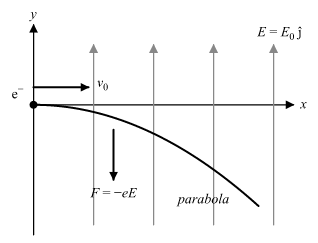 (c) Potential difference: VResult: V (lower plate positive).OR (c) Magnetic field for no deviation:For the beam to go straight, the magnetic force must balance the electric force: . V/m TDirection: The electric force on the electron is downward (towards the lower plate), so the magnetic force must be upward. With to the right, this needs perpendicular to the plane of the paper, pointing out of the paper.Result: T, perpendicular to the plane of the paper, outwards.
© examsnet.com
Go to Question: