Test Index
Electric Charges and Fields
Electric Charges and Fields

 CBSE Board Videos
© examsnet.com
Question : 20 of 29
Marks:
+1,
-0
(a) (i) Define electric flux and write its SI unit.(ii) Use Gauss' law to obtain the expression for the electric field due to a uniformly charged infinite plane sheet.(iii) A cube of side L is kept in space, as shown in the figure. An electric field exists in the region. Find the net charge enclosed by the cube.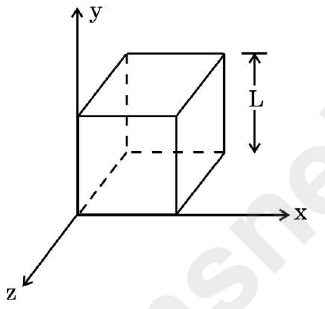 OR(b) (i) Define electric potential at a point and write its SI unit.(ii) Two capacitors are connected in series. Derive an expression of the equivalent capacitance of the combination.(iii) Two point charges and are located at points and respectively in x-y plane. A third charge Q is kept at the origin. Find the value of Q, in terms of q and a, so that the electrostatic potential energy of the system is zero.
[CBSE 2023 55/3/1]
Solution:
(a)(i) Electric flux:Electric flux through a surface is the total number of electric field lines passing normally through it: (for a uniform field and a plane area, ).SI unit: (or V m).(a)(ii) Field of a uniformly charged infinite plane sheet:Let be the surface charge density. By symmetry is normal to the sheet, pointing away on both sides (for ). Take a Gaussian cylinder with its axis normal to the sheet and end faces of area on either side.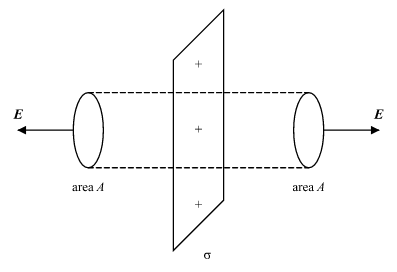 Flux through the curved surface is zero ( is parallel to it). Flux through each end face is .Total flux Charge enclosed By Gauss's law: directed normally away from the sheet; it is independent of the distance from the sheet.(a)(iii) Charge enclosed by the cube:From the figure the cube occupies . is along x, so flux passes only through the two faces perpendicular to x (area each); the other four faces are parallel to .Left face (, outward normal ): Right face (, outward normal ): Net flux By Gauss's law: OR (b)(b)(i) Electric potential:The electric potential at a point is the work done by an external force in bringing a unit positive charge, without acceleration, from infinity to that point: .SI unit: volt (V) .(b)(ii) Capacitors in series:In series, each capacitor carries the same charge , and the applied voltage divides: ., , so For the equivalent capacitor, . Comparing:(b)(iii) Value of Q:Distances: at to at : ; (origin) to : ; to : .Result:
© examsnet.com
Go to Question: