Test Index
Current Electricity
Current Electricity

 CBSE Board Videos
© examsnet.com
Question : 5 of 50
Marks:
+1,
-0
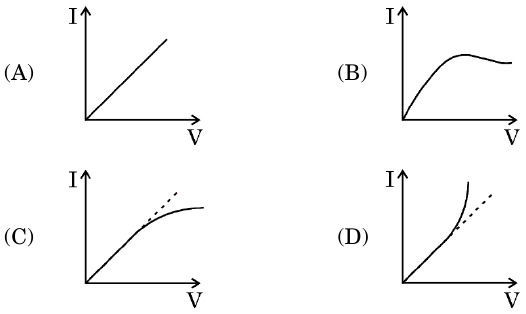
A student sets up the circuit as shown in the figure to find the value of unknown resistance X and records a set of readings of the voltmeter and the ammeter by using the rheostat.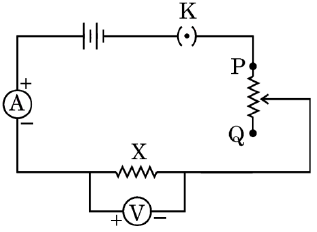 (i) If resistor X were made of manganin and readings for V and I are taken without switching off the circuit, the graph between V and I will be as :
 (ii) Error in the value of X obtained from different sets of voltmeter and ammeter readings, is :(A) due to error in voltmeter reading only.(B) due to error in ammeter reading only.(C) equal to the sum of error in voltmeter reading and error in ammeter reading.(D) equal to error in voltmeter reading divided by the error in ammeter reading.(iii) If the movable end of rheostat is moved towards P, then :(A) reading in ammeter decreases and reading in voltmeter increases.(B) readings in both voltmeter and ammeter increase.(C) reading in ammeter increases and reading in voltmeter decreases.(D) readings in both voltmeter and ammeter decrease.(iv) (a) Suppose the unknown resistance X is replaced by a wire made of the same metal. This wire consists of three parts, of the same length L but has radii r, r/3 and r/2 as shown in the figure.
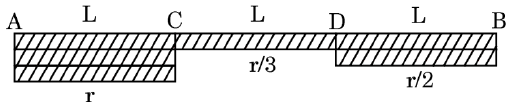 For a particular setting of the rheostat, let , and be the value of drift velocities in parts AC, CD and DB. Then :(A) (B) (C) (D) OR(b) Consider the same wire, as shown in figure in question (iv) (a) connected in place of X. For a particular setting of rheostat, let , and be the value of electric fields in part AC, CD and DB. Then :(A) (B) (C) (D)
[CBSE 2026 55/4/3]
Solution: 👈: Video Solution
(i) When current flows continuously, the resistor heats up. For an ordinary metal the resistance rises with temperature, , and the graph would bend. But manganin is an alloy whose temperature coefficient of resistance is almost zero (), so its resistance stays practically constant even when it is warm. With constant, and the - graph remains a straight line through the origin.Answer: (A)Key point: This is why manganin is used for standard resistors. Graph (C), which bends below the straight line, is what a resistor of an ordinary metal such as copper would give when it heats up.(ii) . For a quotient the relative errors add:So the (fractional) error in is the sum of the (fractional) errors in the voltmeter and ammeter readings.Answer: (C)(iii) The rheostat is connected through end P and the sliding contact, so only the part of the rheostat wire between P and the slider is in the circuit. Moving the slider towards P shortens this part, so the total resistance falls and the current (ammeter reading) increases. The voltmeter reads , which also increases.Answer: (B) readings in both voltmeter and ammeter increase.(iv)(a) The three parts are in series, so the same current flows through each. Drift velocity with , so (same metal, same ).AC (radius ): ; CD (radius ): ; DB (radius ): So .Answer: (B)OR (b) , so for the same metal and the same current , the same ratio as above.So .Answer: (C)
© examsnet.com
Go to Question: