Test Index
Current Electricity
Current Electricity

 CBSE Board Videos
© examsnet.com
Question : 4 of 50
Marks:
+1,
-0
(a) 'Current is a scalar quantity, although we represent current with an arrow.' Explain.(b) Derive the balance condition of a Wheatstone Bridge.
[CBSE 2026 55/4/3]
Solution: 👈: Video Solution
(a) A current has a magnitude and a sense of flow along the conductor, which we show with an arrow. But currents do not add by the laws of vector addition (triangle or parallelogram law). At a junction, currents add algebraically whatever the angles between the wires (Kirchhoff's junction rule): for example, and meeting at a junction always give in the outgoing wire. Hence current is a scalar; the arrow only shows the direction of flow of positive charge (conventional current) along the wire.(b) Wheatstone bridge: four resistances (AB), (BC), (AD) and (DC); a cell between A and C and a galvanometer G (resistance ) between B and D.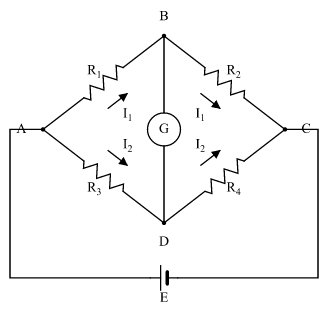 Balance condition: The bridge is balanced when no current flows through the galvanometer, . Then the same current flows through and , and the same current flows through and .Kirchhoff's loop rule for loop ABDA:; with : ...(i)For loop BCDB:; with : ...(ii)Dividing (i) by (ii):This is the balance condition of the Wheatstone bridge (B and D are then at the same potential).
© examsnet.com
Go to Question: