Test Index
Current Electricity
Current Electricity

 CBSE Board Videos
© examsnet.com
Question : 15 of 50
Marks:
+1,
-0
(a) (i) Derive an expression for the resistivity of a conductor in terms of number density of free electrons and relaxation time.(ii) The figure shows the plot of current through a cross-section of wire over two different time intervals. Compare the charges ( and ) that pass through the cross-section during these time intervals.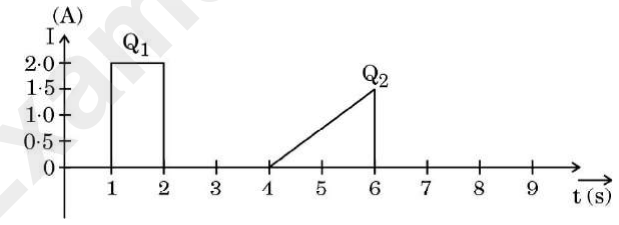 OR(b) (i) A battery of emf E and internal resistance r is connected to a variable external resistance R.(I) Obtain the expression for current I in the circuit and the value of maximum current the battery can supply.(II) Obtain the terminal voltage V across the battery and its maximum possible value.(ii) The above battery sends a current when and a current when . Obtain the internal resistance of the battery in terms of , , and .
[CBSE 2025 55/4/3]
Solution:
(a)(i)Consider a conductor of length and area with a potential difference across it, so the field is . A free electron (charge , mass ) has acceleration (opposite to ).Between collisions it gains velocity ; averaging over the relaxation time (the average time between collisions), the drift velocity isWith free electrons per unit volume, the current is So Comparing with :(a)(ii)Charge passing = area under the – graph (). (rectangle, s to s): (triangle, s to s, peak A): Result: ( is larger).OR (b)(b)(i)(I) The total resistance of the circuit is , so is maximum when the external resistance is zero (, short circuit): (b)(i)(II) Terminal voltage increases with ; as (open circuit, ), .(b)(ii) From for both cases:
© examsnet.com
Go to Question: