Test Index
Current Electricity
Current Electricity

 CBSE Board Videos
© examsnet.com
Question : 14 of 50
Marks:
+1,
-0
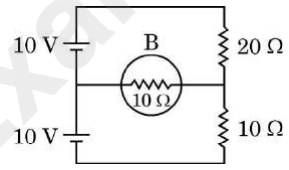
(a) In the given figure, three identical bulbs P, Q and S are connected to a battery.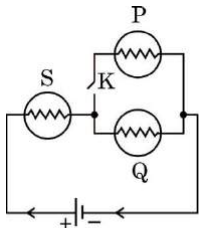 (i) Compare the brightness of bulbs P and Q with that of bulb S when key K is closed.(ii) Compare the brightness of the bulbs S and Q when the key K is opened.Justify your answer in both cases.OR(b) Two cells of emf each, two resistors of and and a bulb B of resistance are connected together as shown in the figure. Find the current that flows through the bulb.
[CBSE 2025 55/4/3]
Solution:
(a)Let each bulb have resistance and the battery emf be . Brightness depends on the power ; for identical bulbs, the bulb carrying more current glows brighter.(a)(i) Key K closed:P and Q are in parallel (equivalent ), and this combination is in series with S.If current flows through S, it divides equally: through P and through Q.Power in S ; power in P = power in Q So S is the brightest; P and Q glow equally, each with one-fourth the power of S.(a)(ii) Key K open:The branch of P is broken, so only S and Q remain, in series. The same current flows through both, so S and Q glow with equal brightness.OR (b)Take the junction between the two cells (left end of the bulb) as . Both cells have their positive terminal upward, so the top wire is at and the bottom wire is at .Let the junction of the and resistors (right end of the bulb) be at potential .Kirchhoff's junction rule at this point (sum of currents flowing in = 0):Multiplying by 20: Current through the bulb (Check: current in , in ; ✓)Result: Current through the bulb B , flowing from the junction of the cells towards the junction of the resistors.
© examsnet.com
Go to Question: