Test Index
Alternating Current
Alternating Current

 CBSE Board Videos
© examsnet.com
Question : 21 of 32
Marks:
+1,
-0
(a) How does the resistance differ from impedance ? With the help of a suitable phasor diagram, obtain an expression for impedance of a series LCR circuit, connected to a source .OR(b) Find the condition for resonance in a series LCR circuit connected to a source , where can be varied. Give the factors on which the resonant frequency of a series LCR circuit depends. Plot a graph showing the variation of electric current with frequency in a series LCR circuit.
[CBSE 2023 55/1/1]
Solution:
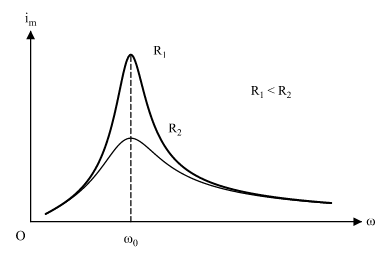
(a)Resistance and impedance:1. Resistance is the opposition to both dc and ac by the resistor; impedance is the total opposition to ac offered by a combination of resistance and reactances.2. Resistance does not depend on frequency; impedance depends on the frequency of the source.Impedance of a series LCR circuit:The same current flows through R, L and C. Taking the current phasor as reference: is in phase with ; leads by ; lags by , where and .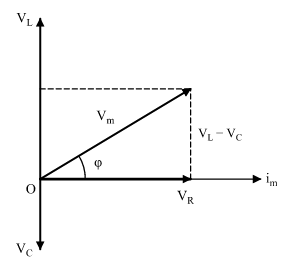 and are along the same line in opposite directions, so their resultant is , perpendicular to . The source voltage is the vector sum:Result: , and the voltage leads the current by , .OR (b)Condition for resonance:As is varied, is maximum when is minimum, i.e. when :, At resonance and (maximum).Factors: The resonant frequency depends only on the inductance and the capacitance of the circuit (it does not depend on or on the source voltage).Graph: current amplitude against angular frequency; it peaks at , and the peak is sharper for smaller .
© examsnet.com
Go to Question: