Test Index

Alternating Current Get it on Google PlayDownload on the App Store CBSE Board Videos

© examsnet.com
Question : 20 of 32
Marks: +1, -0
(a) A resistor of 30 Ω30\ \Omega and a capacitor of 250π μF\dfrac{250}{\pi}\ \mu\text{F} are connected in series to a 200 V200 \text{ V}, 50 Hz50 \text{ Hz} ac source. Calculate (i) the current in the circuit, and (ii) voltage drops across the resistor and the capacitor. (iii) Is the algebraic sum of these voltages more than the source voltage ? If yes, solve the paradox.
OR
(b) A series LCR circuit with R=20 ΩR = 20\ \Omega, L=2 HL = 2 \text{ H} and C=50 μFC = 50\ \mu\text{F} is connected to a 200200 volts ac source of variable frequency. What is (i) the amplitude of the current, and (ii) the average power transferred to the circuit in one complete cycle, at resonance ? (iii) Calculate the potential drop across the capacitor.
[CBSE 2023 55/4/1]
Solution:  
(a) Given: R=30 ΩR = 30\ \Omega, C=250π μFC = \dfrac{250}{\pi}\ \mu\text{F}, V=200 VV = 200 \text{ V} (rms), f=50 Hzf = 50 \text{ Hz}
XC=12πfC=12π×50×250π×10−6=125000×10−6=40 ΩX_C = \dfrac{1}{2\pi f C} = \dfrac{1}{2\pi \times 50 \times \dfrac{250}{\pi} \times 10^{-6}} = \dfrac{1}{25000 \times 10^{-6}} = 40\ \Omega
Z=R2+XC2=302+402=50 ΩZ = \sqrt{R^2 + X_C^2} = \sqrt{30^2 + 40^2} = 50\ \Omega
(i) I=VZ=20050=4 AI = \dfrac{V}{Z} = \dfrac{200}{50} = 4 \text{ A} (rms)
(ii) VR=IR=4×30=120 VV_R = IR = 4 \times 30 = 120 \text{ V}
VC=IXC=4×40=160 VV_C = IX_C = 4 \times 40 = 160 \text{ V}
(iii) Yes: VR+VC=280 V>200 VV_R + V_C = 280 \text{ V} > 200 \text{ V}. The paradox is solved by noting that VRV_R and VCV_C are not in phase: VRV_R is in phase with the current while VCV_C lags the current by 90∘90^\circ. So they add as phasors, not algebraically:
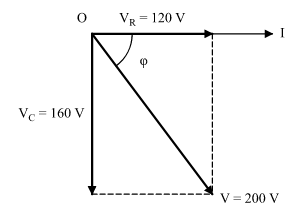
V=VR2+VC2=1202+1602=14400+25600=200 VV = \sqrt{V_R^2 + V_C^2} = \sqrt{120^2 + 160^2} = \sqrt{14400 + 25600} = 200 \text{ V}, equal to the source voltage.
OR (b) Given: R=20 ΩR = 20\ \Omega, L=2 HL = 2 \text{ H}, C=50 μFC = 50\ \mu\text{F}, V=200 VV = 200 \text{ V} (rms)
(i) At resonance XL=XCX_L = X_C, so Z=RZ = R:
Irms=VR=20020=10 AI_{\text{rms}} = \dfrac{V}{R} = \dfrac{200}{20} = 10 \text{ A}
Amplitude I0=2 Irms=1.414×10=14.14 AI_0 = \sqrt{2}\,I_{\text{rms}} = 1.414 \times 10 = 14.14 \text{ A}
(ii) At resonance the power factor is 1:
P=Irms2R=102×20=2000 WP = I_{\text{rms}}^2 R = 10^2 \times 20 = 2000 \text{ W}
(iii) ω0=1LC=12×50×10−6=110−2=100 rad/s\omega_0 = \dfrac{1}{\sqrt{LC}} = \dfrac{1}{\sqrt{2 \times 50 \times 10^{-6}}} = \dfrac{1}{10^{-2}} = 100 \text{ rad/s}
XC=1ω0C=1100×50×10−6=200 ΩX_C = \dfrac{1}{\omega_0 C} = \dfrac{1}{100 \times 50 \times 10^{-6}} = 200\ \Omega
VC=IrmsXC=10×200=2000 VV_C = I_{\text{rms}} X_C = 10 \times 200 = 2000 \text{ V} (rms)
Result: I0=14.14 AI_0 = 14.14 \text{ A}, P=2000 WP = 2000 \text{ W}, VC=2000 VV_C = 2000 \text{ V} (ten times the source voltage; the equal and opposite VLV_L cancels it).
© examsnet.com
Advertisements
Go to Question:

