Test Index
CBSE Class 12 Physics 2019 Delhi Set 1 Paper
© examsnet.com
Question : 26 of 27
Marks:
+1,
-0
(a) Describe any two characteristic features which distinguish interference and diffraction phenomena. Derive the expression for the intensity at a point of the interference pattern in Young's double slit experiment. (b) In the diffraction due to a single slit experiment, the aperture of the slit is 3 . If monochromatic light of wavelength is incident normally on the slit, calculate the separation between the first order minima and the 3rd order maxima on one side of the screen. The distance between the slit and the screen is . OR (a) Under what conditions is the phenomenon of total internal reflection of light observed? Obtain the relation between the critical angle of incidence and the refractive index of the medium. (b) Three lenses of focal lengths and are arranged coaxially as in the figure given below. Find the position of the final image formed by the combination. 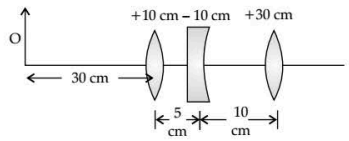
Solution:
(a) Two characteristic features of distinction Derivation of the expression for the intensity (b) Calculation of separation between the first order (a) (Any two of the following) (i) Interference pattern has number of equally spaced bright and dark bands while diffraction pattern has central bright maximum which is twice as wide as the other maxima. (ii) Interference is obtained by the superposing two waves originating from two narrow slits. The diffraction pattern is the superposition of the continuous family of waves originating from each point on a single slit. (iii) In interference pattern, the intensity of all bright fringes is same, while in diffraction pattern intensity of bright fringes go on decreasing with the increasing order of the maxima. (iv) In interference pattern, the first maximum falls at an angle of . where is the separation between two narrow slits, while in diffraction pattern, at the same angle first minimum occurs. (where ' ' is the width of single slit.) Displacement produced by source Displacement produced by the other source ' Resultant displacement Amplitude of resultant wave Intensity (b) Distance of first order minima from centre of the central maxima Distance of third order maxima from centre of the central maxima Distance between first order minima and third order maxima OR (a) Two conditions of total internal reflection (b) Obtaining the relation (c) Calculating of the position of the final image (a) (i) Light travels from denser to rarer medium. (ii) Angle of incidence is more than the critical angle (b) For the Grazing incidence (c) For convex lens of focal length Object distance for concave lens For third lens
© examsnet.com
Go to Question: