Test Index
CBSE Class 12 Physics 2019 Delhi Set 1 Paper
© examsnet.com
Question : 25 of 27
Marks:
+1,
-0
SECTION -D
(a) In a series LCR circuit connected across an ac source of variable frequency, obtain the expression for its impedance and draw a plot showing its variation with frequency of the ac source. (b) What is the phase difference between the voltages across inductor and the capacitor at resonance in the LCR circuit? (c) When an inductor is connected to voltage, a current of 1A flows through it. When the same inductor is connected to a ac source, only current flows. Explain why? Also calculate the self inductance of the inductor. OR (a) Draw the diagram of a device which is used to decrease high ac voltage into a low ac voltage and state its working principle. Write four sources of energy loss in this device. (b) A small town with a demand of of electric power at is situated away from an electric plant generating power at . The resistance of the two wire line carrying power is per . The town gets the power from the line through a 4000-220 V step-down transformer at a substation in the town. Estimate the line power loss in the form of heat.
Solution:
(a) Derivation of the expression for impedance 2 Plot of impedance with frequency (b) Phase difference between voltage across inductor and capacitor (c) Reason and calculation of self induction (a) 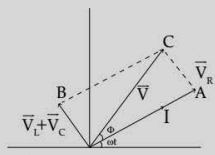 From the figure, the pythagoras theorem gives or, [Note: award these two marks, If a student does it correctly for the other case i.e.,
 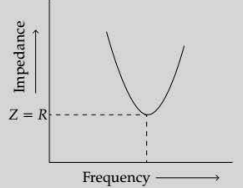 (b) Phase difference between voltage across inductor and the capacitor at resonance is . (c) Inductor will offer an additional impedance to due to its self inductance. Impedance of the inductor Since, Inductance OR (a)
 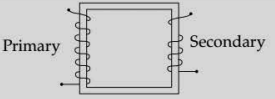 Working Principle: When the alternating voltage is applied to the primary, the resulting current produces an alternating magnetic flux in secondary and induces an emf in it. It works on the principle of mutual induction. Four sources of energy loss: (i) Flux leakage between primary and secondary windings. (ii) Resistance of the windings. (iii) Production of eddy currents in the iron core. (iv) Magnetization of the core. (b) Total resistance of the line Current flowing in the line Line loss in the form of heat
© examsnet.com
Go to Question: