Test Index
Linear Programming
Linear Programming

 CBSE Board Videos
© examsnet.com
Question : 6 of 33
Marks:
+1,
-0
Solve the following Linear Programming Problem graphically :Maximize subject to constraints.
[CBSE 2026 65/5/3]
Solution:
Concept:Draw the boundary lines, shade the region that satisfies all constraints, and evaluate at each corner point of the bounded feasible region; the largest value is the maximum.Boundary lines:: passes through and . Origin satisfies , so the region is towards the origin.: passes through and . Origin satisfies , so the region is towards the origin.Intersection of the two lines:, then . Point .The feasible region is the bounded region OABC shown shaded: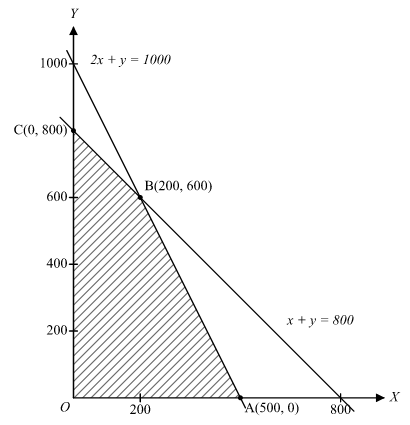 Corner points:
Result: Maximum at , .
| Corner point | |
| (maximum) | |
© examsnet.com
Go to Question: