Test Index
Linear Programming
Linear Programming

 CBSE Board Videos
© examsnet.com
Question : 5 of 33
Marks:
+1,
-0
Assertion (A): Consider a Linear Programming Problem with minimise subject to constraints , , which gives minimum at infinitely many points. The corner points of feasible region are and .Reason (R): If two corner points produce the same minimum value of the objective function, then every point on the line segment joining the points will give the same minimum value.
[CBSE 2026 65/5/3]
Solution:
Concept:If an LPP attains its optimum at two corner points, it attains the same optimum at every point of the segment joining them (infinitely many optimal points).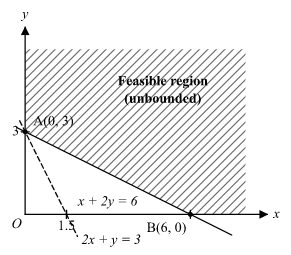 Checking Assertion: meets the axes at and ; meets them at and .On the segment from to , , so the feasible region is the unbounded region on or above in the first quadrant, with corner points and .At : ; at : .Since the region is unbounded, check : it has no point in common with the feasible region (every feasible point has ). So minimum , attained at every point of segment : infinitely many points. Assertion is true.Reason: True (standard result), and it is exactly why the minimum occurs at infinitely many points here.Answer:Option A (Both A and R are true and R is the correct explanation of A)
© examsnet.com
Go to Question: