Test Index

Application of Derivatives Get it on Google PlayDownload on the App Store CBSE Board Videos

© examsnet.com
Question : 9 of 45
Marks: +1, -0
Find the sub-interval of (0,∞)(0, \infty) in which f(x)=xlog⁡xf(x) = x \log x is increasing.
[CBSE 2026 65/3/3]
Solution:  
Concept: ff is increasing where f′(x)>0f'(x) > 0.
f(x)=xlog⁡x⇒f′(x)=x⋅1x+log⁡x=1+log⁡xf(x) = x \log x \Rightarrow f'(x) = x \cdot \dfrac{1}{x} + \log x = 1 + \log x
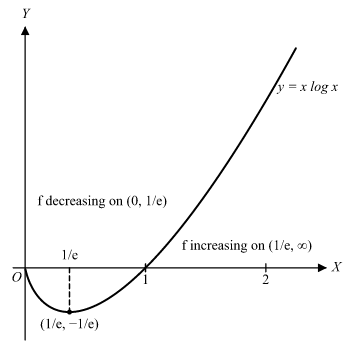
f′(x)=0⇒log⁡x=−1⇒x=1ef'(x) = 0 \Rightarrow \log x = -1 \Rightarrow x = \dfrac{1}{e}
For 0<x<1e0 < x < \dfrac{1}{e}: log⁡x<−1\log x < -1, so f′(x)<0f'(x) < 0 (decreasing).
For x>1ex > \dfrac{1}{e}: log⁡x>−1\log x > -1, so f′(x)>0f'(x) > 0 (increasing).
Result: f(x)f(x) is increasing on (1e,∞)\left(\dfrac{1}{e}, \infty\right) (equivalently [1e,∞)\left[\dfrac{1}{e}, \infty\right)).
© examsnet.com
Advertisements
Go to Question: