Test Index

Application of Derivatives Get it on Google PlayDownload on the App Store CBSE Board Videos

© examsnet.com
Question : 10 of 45
Marks: +1, -0
Case Study - 2
Two vertical light poles of height 22 m and 16 m stand on the opposite sides of a 20 m wide road as shown below in the figure.
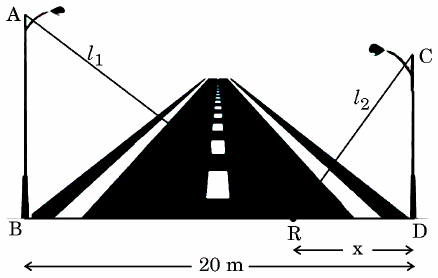
Two ladders of length l1l_1 and l2l_2 are placed from a common point R on the road at a distance of xx m from the smaller pole.
Based on the above information, answer the following questions :
(i) Express p(x)=l1+l2p(x) = l_1 + l_2 in terms of xx. (1)
(ii) Find p′(x)p'(x). (1)
(iii) (a) Find the value of xx for which l12+l22l_1^2 + l_2^2 is minimum. (2)
OR
(iii) (b) If the 22 m long pole is also replaced by a 16 m long pole, at what distance from either pole should the ladders be kept so that the sum of squares of lengths of ladders needed to reach the top of the pole is minimum ? (2)
[CBSE 2026 65/3/3]
Solution:  
Given: AB=22AB = 22 m (taller pole), CD=16CD = 16 m (smaller pole), BD=20BD = 20 m, RD=xRD = x m, so BR=20−xBR = 20 - x m, 0≤x≤200 \le x \le 20. Triangles ABR and CDR are right-angled at B and D.
(i) By Pythagoras theorem:
l1=AR=(20−x)2+222=(20−x)2+484l_1 = AR = \sqrt{(20 - x)^2 + 22^2} = \sqrt{(20 - x)^2 + 484}
l2=CR=x2+162=x2+256l_2 = CR = \sqrt{x^2 + 16^2} = \sqrt{x^2 + 256}
p(x)=(20−x)2+484+x2+256p(x) = \sqrt{(20 - x)^2 + 484} + \sqrt{x^2 + 256}
(ii) Using ddxu=12ududx\dfrac{d}{dx}\sqrt{u} = \dfrac{1}{2\sqrt{u}}\dfrac{du}{dx}:
p′(x)=2(20−x)(−1)2(20−x)2+484+2x2x2+256=xx2+256−20−x(20−x)2+484p'(x) = \dfrac{2(20 - x)(-1)}{2\sqrt{(20 - x)^2 + 484}} + \dfrac{2x}{2\sqrt{x^2 + 256}} = \dfrac{x}{\sqrt{x^2 + 256}} - \dfrac{20 - x}{\sqrt{(20 - x)^2 + 484}}
(iii)(a) Let S(x)=l12+l22=(20−x)2+484+x2+256S(x) = l_1^2 + l_2^2 = (20 - x)^2 + 484 + x^2 + 256.
S′(x)=−2(20−x)+2x=4x−40S'(x) = -2(20 - x) + 2x = 4x - 40
S′(x)=0⇒x=10S'(x) = 0 \Rightarrow x = 10
S′′(x)=4>0S''(x) = 4 > 0, so SS is minimum at x=10x = 10.
Result: l12+l22l_1^2 + l_2^2 is minimum when x=10x = 10 m (minimum value 100+484+100+256=940 m2100 + 484 + 100 + 256 = 940 \text{ m}^2).
OR (iii)(b) Both poles are now 16 m high:
S(x)=(20−x)2+162+x2+162=(20−x)2+x2+512S(x) = (20 - x)^2 + 16^2 + x^2 + 16^2 = (20 - x)^2 + x^2 + 512
S′(x)=−2(20−x)+2x=4x−40=0⇒x=10S'(x) = -2(20 - x) + 2x = 4x - 40 = 0 \Rightarrow x = 10, and S′′(x)=4>0S''(x) = 4 > 0 (minimum).
Result: The ladders should be kept at 1010 m from each pole, i.e. at the middle of the road (minimum sum of squares =100+256+100+256=712 m2= 100 + 256 + 100 + 256 = 712 \text{ m}^2).
Key point: The pole heights are constants, so they do not change S′(x)S'(x); the minimum of (20−x)2+x2(20 - x)^2 + x^2 is always at the midpoint x=10x = 10.
© examsnet.com
Advertisements
Go to Question:

