Test Index
Determination of Income and Employment
Determination of Income and Employment

 CBSE Board Videos
© examsnet.com
Question : 9 of 70
Marks:
+1,
-0
The Aggregate Demand (AD) curve lies parallel to consumption curve, indicating that both have __________ .(Choose the correct option to fill in the blank)
[CBSE 2026 58/2/1]
Solution:
Concept:In a two-sector economy, , where investment is autonomous (it does not change with income).Explanation:The AD curve is obtained by adding the same amount to the consumption curve at every level of income. So AD is the C curve shifted up by , and the vertical gap between them is the same everywhere.Slope of C (MPC); slope of AD (since ). Equal slopes make the two lines parallel.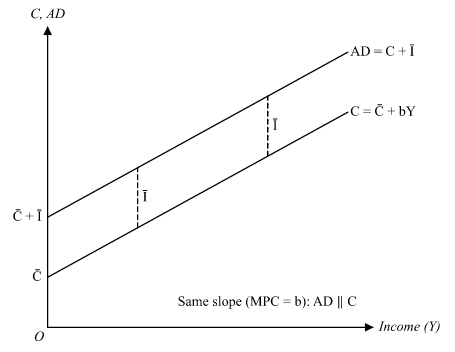 AD has an extra component (investment), so option A is wrong; parallel lines cannot have different slopes (B); both curves rise with income, so there is no inverse relationship (D).Answer:Option C (same slope)
© examsnet.com
Go to Question: