Test Index
Determination of Income and Employment
Determination of Income and Employment

 CBSE Board Videos
© examsnet.com
Question : 10 of 70
Marks:
+1,
-0
(A) (I) Estimate the value of subsistence level of consumption expenditure from the following data about an economy which is in equilibrium : (3)(i) National Income (Y) = ₹ 1,200 crore(ii) Marginal Propensity to Save (MPS) = 0.20(iii) Investment Expenditure () = ₹ 100 crore(II) “An economy facing an increase in unintended accumulation of inventories would try to reduce Aggregate Demand.”Defend or refute the above statement with valid arguments. (3)OR(B) (I) Complete the following table : (½ × 6 = 3)
(II) Identify the monetary measures being referred to in the following statements. Discuss whether the tool would be used during a situation of excess demand or deficient demand.(i) Selling off government securities (G-Sec) to public by the central bank. (1½)(ii) Encourage commercial banks to park their surplus funds with the Reserve Bank of India (RBI). (1½)
| Situation | Change in Investment () | Change in Income () | Marginal Propensity to Consume (MPC) | Investments Multiplier (K) |
| (a) | 200 | (i) ____ | 0.8 | (ii) ____ |
| (b) | (iii) ____ | 2000 | (iv) ____ | 4 |
| (c) | 1000 | (v) ____ | 0.5 | (vi) ____ |
[CBSE 2026 58/2/1]
Solution:
(A)(I)Given: ₹ 1,200 crore, , ₹ 100 croreAt equilibrium, , where the consumption function is ( = autonomous or subsistence consumption, = MPC).Result: Subsistence (autonomous) consumption expenditure ₹ 140 crore.(A)(II)The statement is refuted.1. What the inventories show: an unintended rise in inventories means planned Aggregate Supply is more than planned Aggregate Demand (); households and firms plan to buy less than what producers plan to produce.2. Who adjusts: the producers respond, not the buyers. Aggregate Demand is the planned spending of buyers; the economy does not try to cut it.3. Adjustment: to clear the unwanted stock, producers reduce output and employ fewer factors, so income falls.4. New equilibrium: output and income keep falling until (point E) and there is no unplanned change in inventories.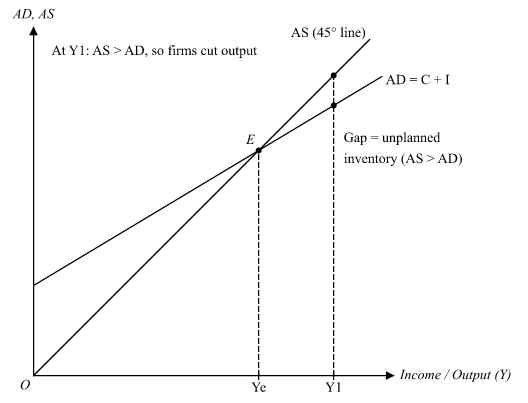 OR (B)(B)(I)Formulas used: and Situation (a): ; Situation (b): ; , so and Situation (c): ;
(B)(II)(i)Measure: Open Market Operations (OMO), an outright sale of government securities.Used during: excess demand. When the central bank sells G-Secs, buyers pay for them from their bank deposits, so the reserves of commercial banks and their capacity to create credit fall. Money supply falls, borrowing and spending fall, and Aggregate Demand comes down to the full-employment level.(B)(II)(ii)Measure: Reverse Repo Rate (the rate at which the RBI pays commercial banks on funds they park with it).Used during: excess demand. The RBI raises the reverse repo rate, so parking surplus funds with the RBI becomes more attractive. Banks keep more funds with the RBI and lend less to the public; credit and money supply shrink, and Aggregate Demand falls.Key point: Both measures take money out of the system. In deficient demand the RBI does the opposite: it buys securities and lowers the reverse repo rate.
| Situation | Change in Investment () | Change in Income () | Marginal Propensity to Consume (MPC) | Investments Multiplier (K) |
| (a) | 200 | (i) 1000 | 0.8 | (ii) 5 |
| (b) | (iii) 500 | 2000 | (iv) 0.75 | 4 |
| (c) | 1000 | (v) 2000 | 0.5 | (vi) 2 |
© examsnet.com
Go to Question: