Test Index
Aldehydes, Ketones and Carboxylic Acids
Aldehydes, Ketones and Carboxylic Acids

 CBSE Board Videos
© examsnet.com
Question : 42 of 45
Marks:
+1,
-0
(a) Write the major products in the following: (3×1=3)(i)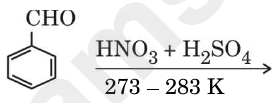 (ii)
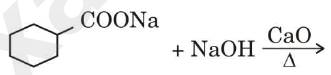 (iii) OR(b) (i) Oxidation of propanal is easier than propanone. Why?(ii) How can you distinguish between Acetophenone and Benzophenone?(iii) Draw the structure of the following derivative:2,4-Dinitrophenylhydrazone of Propanone (3×1=3)
[CBSE 2022 56/2/2]
Solution:
(a)(i) Nitration: is a deactivating, meta-directing group.Major product: 3-nitrobenzaldehyde (m-nitrobenzaldehyde)(a)(ii) Decarboxylation: the sodium salt heated with soda-lime loses .Major product: cyclohexane(a)(iii) Hydroxylamine condenses with the carbonyl group (loss of water).Major product: ethanal oxime (acetaldoxime)OR (b)(i) Propanal has a hydrogen atom on the carbonyl carbon; on oxidation this bond is converted to , giving propanoic acid easily (even mild oxidants work). Propanone has no such H; its oxidation needs cleavage of a bond, which is stronger, so it needs vigorous conditions.(ii) Iodoform test: warm each with and . Acetophenone (, has a group) gives a yellow precipitate of iodoform (); benzophenone () does not.(iii) 2,4-Dinitrophenylhydrazone of propanone, :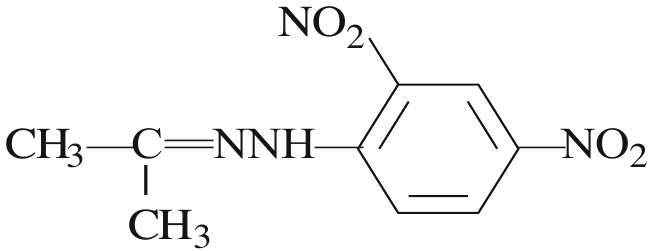
© examsnet.com
Go to Question: