Test Index
Aldehydes, Ketones and Carboxylic Acids
Aldehydes, Ketones and Carboxylic Acids

 CBSE Board Videos
© examsnet.com
Question : 41 of 45
Marks:
+1,
-0
(a) Write the equations involved in the following reactions: (3×1=3)(i) Cannizzaro reaction(ii) Aldol condensation(iii) Hell-Volhard-Zelinsky reactionOR(b) (i) Which acid of each pair would you expect to be stronger? Give reason. (2+1=3)(I) or (II)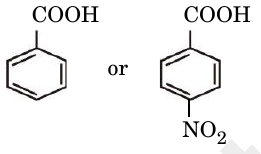 (ii) Distinguish between Propanal and Propanone.
[CBSE 2022 56/2/2]
Solution:
(a)(i) Cannizzaro reaction (aldehyde with no -H, conc. alkali; disproportionation)(one molecule is oxidised to the acid salt, the other reduced to the alcohol)(a)(ii) Aldol condensation (aldehyde with -H, dilute alkali)(3-hydroxybutanal, the aldol, then but-2-enal)(a)(iii) Hell-Volhard-Zelinsky reaction (-halogenation of a carboxylic acid)OR (b)(i)(I) is stronger. F is more electronegative than Cl, so its electron-withdrawing () effect is stronger; it stabilises the carboxylate anion more.(i)(II) 4-Nitrobenzoic acid is stronger. The group is strongly electron-withdrawing ( and effects), which disperses the negative charge and stabilises the carboxylate anion.(ii) Tollens' test: warm each with Tollens' reagent. Propanal () gives a silver mirror; propanone does not.(Or iodoform test: warm with and ; propanone () gives a yellow precipitate of , propanal does not.)
© examsnet.com
Go to Question: