Test Index
Aldehydes, Ketones and Carboxylic Acids
Aldehydes, Ketones and Carboxylic Acids

 CBSE Board Videos
© examsnet.com
Question : 2 of 45
Marks:
+1,
-0
(a) (i) Write the product(s) when :(I) One mol of ethanal is treated with 1 mol of in the presence of dry HCl gas.(II) Benzaldehyde is treated with conc. NaOH.(III) Ethanoic acid is heated in the presence of .(ii) Write a simple chemical test to distinguish between Ethanal and Propanal.(iii) Write the name of the reagent to transform Allyl alcohol to Propenal.OR(b) (i) Draw the structure of the semicarbazone of acetone.(ii) Why are -hydrogen atoms of aldehydes and ketones acidic in nature ?(iii) Arrange the following compounds in increasing order of their reactivity towards HCN :, , (iv) Write the reaction involved in Etard reaction.(v) Write the product when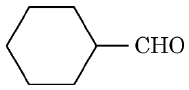 reacts with Zn(Hg)/conc. HCl.
[CBSE 2026 56/3/2]
Solution: 👈: Video Solution
(a)(i)(I) One equivalent of a monohydric alcohol adds to the aldehyde in dry HCl to give a hemiacetal (1-methoxyethanol):(With excess methanol this reacts further to give the acetal .)(II) Benzaldehyde has no -hydrogen, so with conc. NaOH it undergoes the Cannizzaro reaction (self oxidation–reduction):Products: benzyl alcohol and sodium benzoate.(III) removes water from two molecules of the acid, giving ethanoic anhydride:(a)(ii) Iodoform test: warm each compound with NaOH and iodine (). Ethanal (, has the group) gives a yellow precipitate of iodoform (); propanal () does not.(a)(iii) Pyridinium chlorochromate (PCC). It oxidises the primary alcohol only to the aldehyde and does not attack the C=C double bond:OR (b)(i) Acetone condenses with semicarbazide () with loss of water: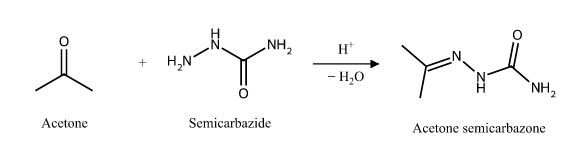 Acetone semicarbazone: (b)(ii) The carbonyl group is strongly electron-withdrawing ( effect), which weakens the C–H bond at the -carbon. Also, the carbanion (enolate ion) formed after losing an -hydrogen is stabilised by resonance, the negative charge being spread onto the oxygen atom. Hence -hydrogens are acidic.(b)(iii) Addition of HCN is a nucleophilic addition. Reactivity falls as (1) more electron-releasing alkyl groups reduce the positive charge on the carbonyl carbon and (2) bulkier groups hinder the approach of . The aldehyde has one H; acetone has two methyl groups; the third ketone carries a bulky tert-butyl group.Increasing order: (b)(iv) Etard reaction: chromyl chloride oxidises the methyl group of toluene to a chromium complex, which on hydrolysis gives benzaldehyde:
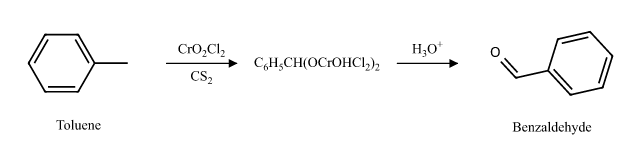 (b)(v) Zn(Hg)/conc. HCl brings about Clemmensen reduction: the group is reduced to . So the –CHO group becomes – and the product is methylcyclohexane.
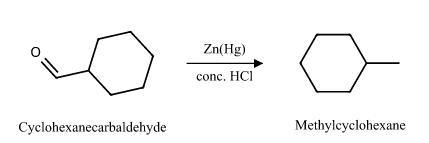 (methylcyclohexane)
© examsnet.com
Go to Question: