Test Index
Aldehydes, Ketones and Carboxylic Acids
Aldehydes, Ketones and Carboxylic Acids

 CBSE Board Videos
© examsnet.com
Question : 1 of 45
Marks:
+1,
-0
An organic compound (A) with molecular formula on reaction with followed by hydrolysis, gives a compound (B). Compound (B) forms an orange-red precipitate with 2,4-DNP reagent and does not give iodoform test. It neither reduces Tollens' or Fehling's reagent nor does it decolourise bromine water. On drastic oxidation with chromic acid it gives a carboxylic acid (C) having molecular formula . Identify the compounds (A), (B) and (C). Write the reactions of compound (A) with followed by hydrolysis to give compound (B).
[CBSE 2026 56/3/2]
Solution: 👈: Video Solution
Reasoning:• (B) gives an orange-red precipitate with 2,4-DNP: it has a carbonyl group.• It does not reduce Tollens' or Fehling's reagent: it is a ketone, not an aldehyde.• No iodoform test: it is not a methyl ketone (no group).• It does not decolourise bromine water: no C=C in the side chain.• Drastic oxidation gives = benzoic acid, : (B) has a benzene ring with one side chain.• A nitrile with a Grignard reagent gives a ketone. is the nitrile ; with it gives , an ethyl ketone, which fits every test.Compounds:(A) , propanenitrile(B) , propiophenone (1-phenylpropan-1-one)(C) , benzoic acidReaction of (A) with followed by hydrolysis: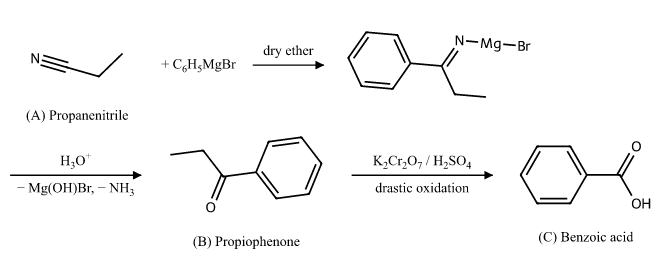 Oxidation of (B): (the side chain is cleaved; the other fragment gives acetic acid).
© examsnet.com
Go to Question: