Test Index
CBSE Class 12 Biology 2025 Paper 57/1/1
CBSE Class 12 Biology 2025 Paper 57/1/1


© examsnet.com
Question : 33 of 33
Marks:
+1,
-0
Student to attempt either option-(A) or (B) :(A) (i) Perform a cross between two sickle cell carriers. What ratio is obtained between carrier, disease free and diseased individuals in progeny ? Name the nitrogenous base substituted, in the haemoglobin molecule in this disease.(ii) Explain the difference in inheritance pattern of flower colour in garden pea plant and snap-dragon plant with the help of monohybrid crosses.OR(B) Explain with the help of well-labelled diagrams how lac operon operates in E. coli :(i) In presence of an inducer.(ii) In absence of an inducer.
Solution:
(A)(i)Sickle-cell anaemia is an autosomal recessive disorder. A carrier is heterozygous, .Parents: (carrier) (carrier)Gametes: , from each parent
Result: carrier : disease free : diseased = 2 : 1 : 1 (2 : 1 : 1 ).Base substitution: in the gene for the -globin chain, adenine is replaced by thymine (GAG → GTG; in mRNA GAG → GUG) at the sixth codon. As a result, glutamic acid (Glu) is replaced by valine (Val) at the sixth position of the -globin chain of haemoglobin.(A)(ii)Garden pea – complete dominance: violet flower colour (V) is completely dominant over white (v).P: VV (violet) vv (white) → : all Vv, violet (the recessive trait is not expressed).: Vv Vv
: phenotypic ratio 3 violet : 1 white; genotypic ratio 1 VV : 2 Vv : 1 vv.Snapdragon – incomplete dominance: red (R) is not completely dominant over white (r), so the heterozygote has an intermediate (pink) colour.P: RR (red) rr (white) → : all Rr, pink.: Rr Rr
: 1 red : 2 pink : 1 white; here the phenotypic ratio is the same as the genotypic ratio (1 : 2 : 1).Key point: In pea the looks like one parent and is 3 : 1; in snapdragon the is intermediate and is 1 : 2 : 1.OR (B)Lac operon: a polycistronic set of genes in E. coli: the regulator gene i (codes for the repressor), the promoter p, the operator o and three structural genes: z (-galactosidase, which hydrolyses lactose into glucose and galactose), y (permease, which increases the permeability of the cell to -galactosides) and a (transacetylase). Lactose is the inducer.(i) In presence of an inducer (lactose):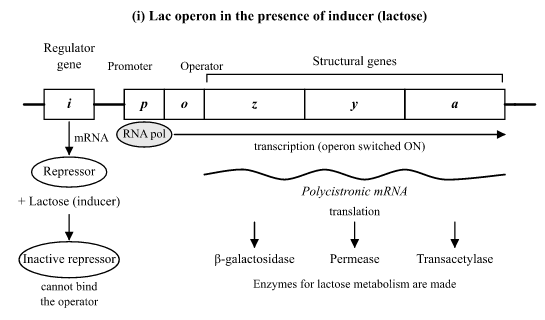 • Lactose enters the cell through permease (a few molecules of the enzymes are always present).• The inducer binds to the repressor and changes its shape, making it inactive; the repressor can no longer bind to the operator.• RNA polymerase binds to the promoter and transcribes the structural genes z, y, a into a polycistronic mRNA.• Its translation produces -galactosidase, permease and transacetylase, and lactose is metabolised. The operon is switched on.(ii) In absence of an inducer:
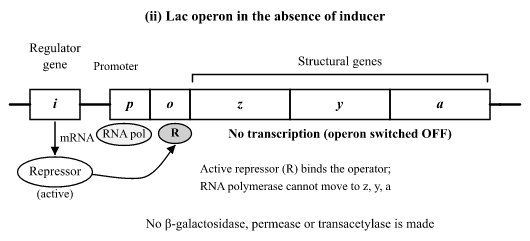 • The regulator gene i is always expressed (constitutive) and makes the repressor protein.• The active repressor binds to the operator and prevents RNA polymerase from transcribing the structural genes.• No enzymes for lactose metabolism are made; the operon is switched off. This is negative regulation of the lac operon.
| ♀ / ♂ | ||
|---|---|---|
| (normal) | (carrier) | |
| (carrier) | (diseased) |
| Gametes | V | v |
|---|---|---|
| V | VV (violet) | Vv (violet) |
| v | Vv (violet) | vv (white) |
| Gametes | R | r |
|---|---|---|
| R | RR (red) | Rr (pink) |
| r | Rr (pink) | rr (white) |
© examsnet.com
Go to Question: