Test Index
CBSE Class 12 Biology 2025 Paper 57/1/1
CBSE Class 12 Biology 2025 Paper 57/1/1


© examsnet.com
Question : 32 of 33
Marks:
+1,
-0
Student to attempt either option-(A) or (B) :(A) (a) Distinguish between the two cells enclosed in a mature male gametophyte of an angiosperm.(b) Study the diagram given below showing the modes of pollination. Answer the questions that follow.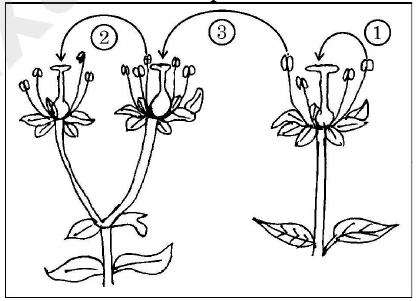 (i) The given diagram shows three methods of pollen transfer in plants. Examine them carefully and write the technical terms used for pollen transfer methods '1', '2' and '3'.(ii) How do the following plants achieve pollination successfully ?(a) Water lily(b) Vallisneria(iii) Write advantages of pollen transfer in method '3'.OR(B) Given below is the diagram of human ovum surrounded by a few sperms. Observe the diagram and answer the questions that follows :
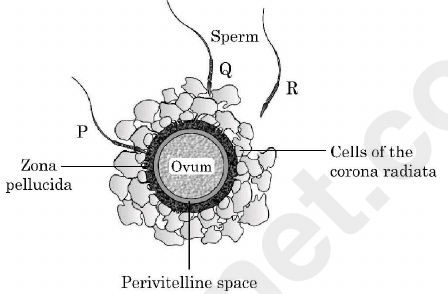 (i) Compare the fate of sperms 'P', 'Q' and 'R' shown in the diagram.(ii) Write the role of Zona pellucida in this process.(iii) Analyse the changes occurring in the ovum after the entry of sperm.(iv) How acrosome and middle piece of a human sperm are able to play an important role in human fertilization ?
Solution:
(A)(a)A mature pollen grain contains a vegetative cell and a generative cell.
(A)(b)(i)1 – Autogamy: pollen of a flower reaches the stigma of the same flower.2 – Geitonogamy: pollen reaches the stigma of another flower of the same plant.3 – Xenogamy: pollen reaches the stigma of a flower on a different plant.(A)(b)(ii)(a) Water lily: although it is an aquatic plant, its flowers emerge above the level of water and are pollinated by insects or wind, as in most land plants.(b) Vallisneria: pollination by water. The female flower reaches the surface of water by its long stalk; the male flowers or pollen grains are released onto the surface of water and are carried passively by water currents; some of them reach the female flowers and the stigma.(A)(b)(iii) Advantages of xenogamy (any two):• It brings genetically different pollen to the stigma, so it produces genetic variation (new combinations of characters) in the offspring.• It avoids inbreeding depression; the offspring are healthier and more vigorous.• Variation helps the species to adapt to a changing environment and to evolve.OR (B)(i)Sperm P has passed through the corona radiata and is in contact with the zona pellucida, so it will enter and fertilise the ovum. Sperms Q and R are still outside; once P makes contact, entry of other sperms is blocked, so Q and R cannot fertilise the ovum and degenerate. Only one sperm fertilises an ovum.OR (B)(ii)When a sperm comes in contact with the zona pellucida layer of the ovum, it induces changes in the membrane that block the entry of additional sperms. This ensures that only one sperm fertilises the ovum (prevents polyspermy).OR (B)(iii)• The entry of the sperm induces the completion of the meiotic (second meiotic) division of the secondary oocyte.• This unequal division forms a small second polar body and a haploid ovum (ootid).• The haploid nucleus of the sperm then fuses with that of the ovum, forming a diploid zygote.OR (B)(iv)• Acrosome: the cap-like structure on the head of the sperm is filled with enzymes that help in fertilisation; they dissolve the layers around the ovum so that the sperm can enter.• Middle piece: it has numerous mitochondria, which produce energy for the movement of the tail; this gives the sperm the motility needed to reach the ovum.
| Vegetative cell | Generative cell |
|---|---|
| Bigger, with abundant food reserve | Small |
| Large, irregularly shaped nucleus | Spindle-shaped with dense cytoplasm and a nucleus; floats in the cytoplasm of the vegetative cell |
| Forms the pollen tube | Divides mitotically to form the two male gametes |
© examsnet.com
Go to Question: