Test Index
CBSE Class 12 Biology 2024 Paper 57/1/2
CBSE Class 12 Biology 2024 Paper 57/1/2


© examsnet.com
Question : 33 of 33
Marks:
+1,
-0
(a) (i) Explain the development of male gametophyte in an angiosperm. ()(ii) Draw a labelled diagram of a three-celled male gametophyte. ()OR(b) (i) Draw a diagrammatic sectional view of ovary of human female and label the following : (2)(1) Blood vessels(2) Primary follicle(3) Tertiary follicle(4) Ovum(ii) At which stage of life are primary follicles formed in a human female ? ()(iii) Explain the events (both hormonal and structural) that occur at the time of ovulation till the onset of the next menstrual cycle. ()
Solution:
(a)(i) Development of the male gametophyte (microsporogenesis and pollen development):1. In a young anther, each cell of the sporogenous tissue is a potential pollen (microspore) mother cell (2n).2. Each microspore mother cell undergoes meiosis to form a cluster of four haploid cells, the microspore tetrad. This process is called microsporogenesis.3. As the anther matures and dehydrates, the microspores dissociate from each other and develop into pollen grains; each has a two-layered wall, the outer hard exine (of sporopollenin, with germ pores) and the inner thin intine.4. The pollen grain represents the male gametophyte. Its nucleus undergoes an asymmetric mitotic division to form a large vegetative cell (with abundant food reserve and a large irregular nucleus) and a small spindle-shaped generative cell, which floats in the cytoplasm of the vegetative cell.5. In over 60% of angiosperms pollen grains are shed at this 2-celled stage. In the rest, the generative cell divides mitotically to give rise to two male gametes before shedding (3-celled stage).(a)(ii) Three-celled male gametophyte: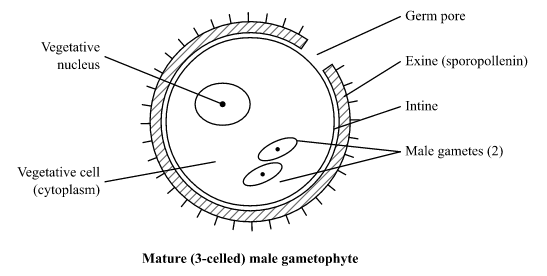 OR (b)(i) Diagrammatic sectional view of the human ovary:
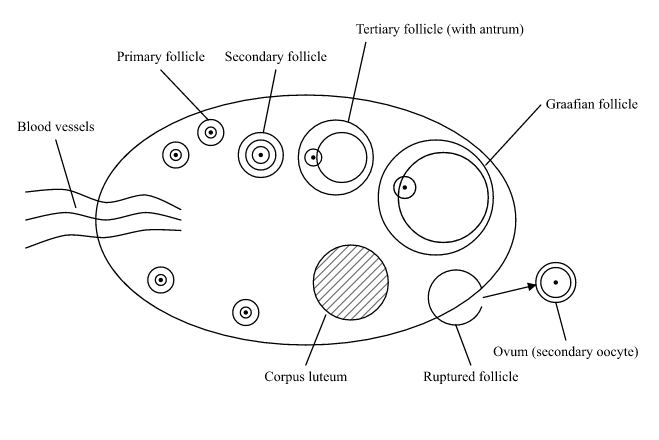 (b)(ii) Primary follicles are formed during the embryonic (foetal) stage, before birth. Oogonia formed in the foetal ovary enter meiosis I and get arrested as primary oocytes; each primary oocyte gets surrounded by a layer of granulosa cells to form a primary follicle. (A large number of these follicles degenerate between birth and puberty.)(b)(iii) Events from ovulation to the next menstrual cycle:1. Both LH and FSH attain a peak level in the middle of the cycle (about day 14). The rapid secretion of LH to its maximum is called the LH surge.2. The LH surge induces rupture of the Graafian follicle and the release of the ovum (secondary oocyte): ovulation.3. Ovulation is followed by the luteal phase: the remaining parts of the Graafian follicle transform into the corpus luteum.4. The corpus luteum secretes large amounts of progesterone, which is essential for maintaining the endometrium for implantation of a fertilised ovum.5. In the absence of fertilisation, the corpus luteum degenerates; progesterone falls, which causes disintegration of the endometrium, leading to menstruation and the start of a new cycle.
© examsnet.com
Go to Question: