Test Index
CBSE Class 12 Biology 2024 Paper 57/1/2
CBSE Class 12 Biology 2024 Paper 57/1/2


© examsnet.com
Question : 32 of 33
Marks:
+1,
-0
(a) Many patterns of inheritance deviate considerably from the pattern of inheritance as explained by Mendel. List any four such inheritance patterns and explain any three with the help of an example each. (2+3)OR(b) (i) Construct a transcription unit with a coding strand given below with proper labelling : (2) (ii) When does a coding strand become a template strand ? (1)(iii) Why does a double-helix DNA molecule transcribe into a single-stranded RNA molecule ? (2)
Solution:
(a) Patterns of inheritance that deviate from Mendel's (any four): incomplete dominance, co-dominance, multiple allelism, pleiotropy, polygenic inheritance, linkage.1. Incomplete dominance: the hybrid has a phenotype intermediate between the two parents, because neither allele is completely dominant.Example: flower colour in snapdragon (dog flower, Antirrhinum). Red (RR) × white (rr) → all pink (Rr). Selfing gives red : pink : white = 1 : 2 : 1 (the genotypic ratio is the same as the phenotypic ratio, unlike Mendel's 3 : 1).2. Co-dominance: both alleles of the express themselves fully.Example: ABO blood groups in humans, controlled by the gene I with alleles , and i. In a person with , both sugar polymers A and B are made on the RBC surface, giving blood group AB.3. Pleiotropy: a single gene affects more than one phenotypic character.Example: phenylketonuria in humans, caused by mutation in the gene for the enzyme phenylalanine hydroxylase; it causes mental retardation and reduced hair and skin pigmentation.4. Polygenic inheritance: one trait is controlled by three or more genes, each allele having an additive effect.Example: human skin colour, controlled by three genes A, B, C. AABBCC is darkest, aabbcc lightest; the number of dominant alleles in the genotype decides the darkness or lightness of skin, giving a continuous range.5. Linkage: genes located close together on the same chromosome do not assort independently; parental combinations are much more frequent than recombinants.Example: body colour and eye colour genes in Drosophila (Morgan): the ratio deviated greatly from 9 : 3 : 3 : 1.OR (b)(i) The coding strand has the same sequence as the RNA (with T in place of U) and is written 5'→3'. The template strand is complementary and antiparallel (3'→5'). The promoter lies at the 5' (upstream) end of the coding strand and the terminator at its 3' (downstream) end: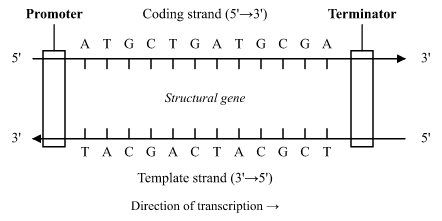 Coding strand: 5'–ATGCTGATGCGA–3'Template strand: 3'–TACGACTACGCT–5'(b)(ii) The promoter decides which strand is the template (RNA polymerase binds the promoter and copies the 3'→5' strand). If the positions of the promoter and the terminator are switched (the promoter placed at the other end), the polarity of transcription reverses and the present coding strand becomes the template strand.(b)(iii) Only one strand is transcribed because (any two):1. If both strands acted as templates, they would code for two RNA molecules with different sequences; if these coded for proteins, one segment of DNA would code for two different proteins, which would complicate the genetic information transfer machinery.2. The two RNA molecules, being complementary to each other, would pair to form double-stranded RNA, which would prevent translation into protein.3. A single-stranded RNA (mRNA) is needed as the template for translation.
© examsnet.com
Go to Question: