Test Index
CBSE Class 12 Biology 2024 Paper 57/1/2
CBSE Class 12 Biology 2024 Paper 57/1/2


© examsnet.com
Question : 30 of 33
Marks:
+1,
-0
Read the following passage and answer the questions that follow.Isn't it incredible that India's land area is only 2.4 per cent of the world's total land area whereas its share of the global species diversity is an impressive 8.1 per cent ! However, in these estimates of species, prokaryotes do not figure anywhere.Biologists are always keen on collecting data with respect to species diversity observed in different regions of the world. The data collected based on the survey conducted for species richness of groups of mammals in three different regions of the world is shown in the bar graph given below :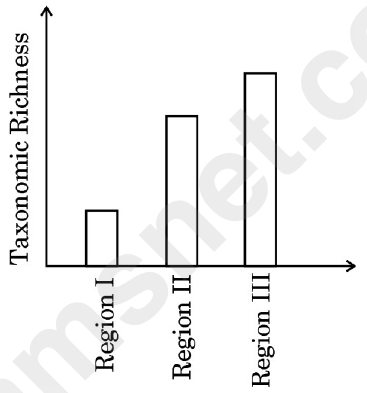 (a) Why is the species richness maximum in Region III in the bar graph ? (1)OR(a) Why is the species richness minimum in Region I in the bar graph ? (1)(b) Plants and animals do not have uniform diversity in the world but show rather uneven distribution. Mention what this kind of diversity is referred to as. (1)(c) Why is it that prokaryotes do not have an estimated number of their species diversity as seen in plants and animals ? Explain. (2)
Solution:
(a) Region III represents the tropics (low latitudes), which have the highest species richness because:1. Tropical latitudes remained relatively undisturbed (no frequent glaciations) for millions of years and so had a long evolutionary time for species diversification.2. The environment is less seasonal, relatively constant and predictable, which promotes niche specialisation and greater diversity.3. More solar energy is available, giving higher productivity, which in turn supports greater diversity.OR (a) Region I represents the temperate (high-latitude) region, where species richness is minimum because:1. It was subjected to frequent glaciations in the past, so it had less evolutionary time for species diversification.2. It is more seasonal, with a less constant and less predictable environment.3. Less solar energy is available, so productivity, and in turn diversity, is lower.(b) This uneven distribution is called the latitudinal gradient in diversity: species diversity decreases as we move away from the equator towards the poles.(c) Prokaryotes are not included in species estimates because:1. Conventional taxonomic methods (based on morphology) are not suitable for identifying microbial species.2. Many microbial species simply cannot be cultured under laboratory conditions, so they cannot be studied and counted.If biochemical or molecular criteria were used to delineate species, prokaryotic diversity alone might run into millions.
© examsnet.com
Go to Question: