Test Index
CBSE Class 12 Biology 2024 Paper 57/1/2
CBSE Class 12 Biology 2024 Paper 57/1/2


© examsnet.com
Question : 29 of 33
Marks:
+1,
-0
Study the diagram given below that shows the steps involved in the procedure of selecting transformed bacteria and answer the questions that follow :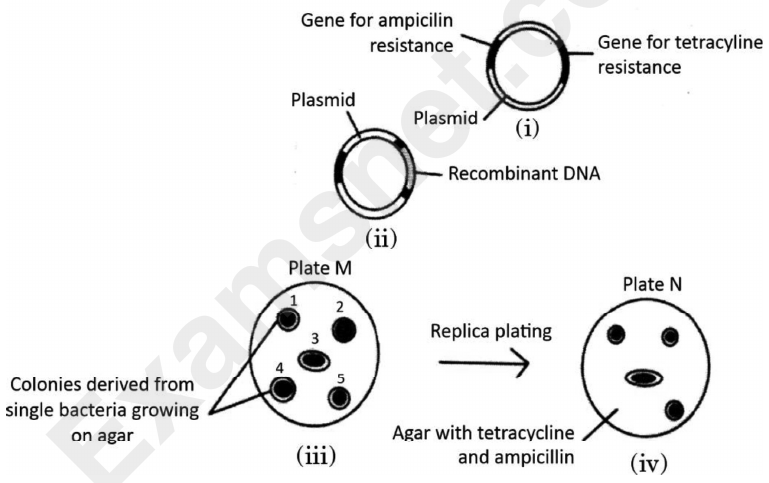 (a) Identify the colony that has got transformed. Justify your answer. ()(b) What are the sites in a plasmid called where ampicillin and tetracycline resistance genes are inserted ? State their role in genetic engineering. (2)(c) Name two enzymes playing an important role in genetic engineering. (1)OR(c) State the role of -galactosidase in insertional inactivation. (1)
Solution:
(a) Colony 4 is the transformed (recombinant) colony. It grows on plate M but is absent on the replica plate N containing tetracycline and ampicillin. The foreign DNA was inserted into the tetracycline resistance gene of the plasmid (plasmid ii), which inactivated this gene (insertional inactivation). So bacteria carrying the recombinant plasmid are still resistant to ampicillin but have lost resistance to tetracycline, and they cannot grow on plate N. Colonies 1, 2, 3 and 5 grow on both plates: they carry the non-recombinant plasmid with both resistance genes intact.(b) The antibiotic resistance genes (ampR and tetR) act as selectable markers, and the sites within them where foreign DNA is ligated are restriction (recognition) sites used as cloning sites (for example, in pBR322 the BamHI site lies in tetR and the PstI/PvuI sites lie in ampR).Role in genetic engineering:1. Selectable markers help in identifying and eliminating non-transformants and selectively permitting the growth of transformants: only bacteria that took up the plasmid survive on a medium with that antibiotic.2. When the foreign DNA is inserted at a restriction site within one resistance gene, that gene is inactivated. Then recombinants (resistant to one antibiotic only) can be told apart from non-recombinants (resistant to both) by replica plating, as in this experiment.(c) Two important enzymes: restriction endonuclease (molecular scissors, cuts DNA at specific sites) and DNA ligase (joins DNA fragments). (Taq DNA polymerase, used in PCR, is another.)OR (c) In insertional inactivation with the lacZ gene, the recombinant DNA is inserted within the coding sequence of the enzyme β-galactosidase, which inactivates the gene. On a medium with a chromogenic substrate, colonies whose plasmid has no insert have active β-galactosidase and give blue colonies, while recombinant colonies cannot make the enzyme and stay colourless. So β-galactosidase acts as a marker for picking out the recombinants.
© examsnet.com
Go to Question: