Test Index
CBSE Class 12 Biology 2023 Paper 57/3/1
CBSE Class 12 Biology 2023 Paper 57/3/1


© examsnet.com
Question : 29 of 33
Marks:
+1,
-0
The following pedigree chart shows the inheritance of a genetic disorder up to three generations of a family. Observe the chart and answer the questions that follow.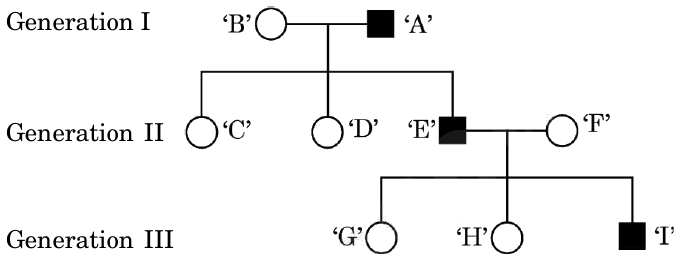 (i) Is the disease sex-linked or autosomal as per the chart ? Give reasons in support of your answer. (1)(ii) Is it a recessive or a dominant disorder ? (1)(iii) Write the genotypes of the individuals ‘C’, ‘D’ and ‘H’. (1)(iv) (a) If the female ‘D’ marries a normal man, what will be the probability of their daughter being a sufferer of this disease ? (1)OR(iv) (b) If the mother ‘B’ is a carrier of the disease, what will be the probability of their daughter being a sufferer of this disease ? (1)
Solution:
Let be the X chromosome carrying the defective (recessive) allele and the normal one.(i) The disease is sex-linked (X-linked). Only males (A, E, I) are affected in all three generations, while all the females are normal. Males have only one X chromosome, so a single defective allele on it is expressed; females need two copies.It is not X-linked dominant, because the affected father A has normal daughters C and D (an X-linked dominant trait of the father would show in every daughter).(ii) It is a recessive disorder: it skips the females who carry it (C, D, G, H are normal but carry it), and affected sons (E, I) are born to normal mothers.(iii) C, D and H are daughters of an affected father, and a father passes his X chromosome to every daughter. So each is a carrier:C: , D: , H: (iv)(a) D (carrier, ) normal man ():
Every daughter gets the normal from the father, so no daughter can be a sufferer (half of them are carriers).Result: probability of a daughter being a sufferer OR (iv)(b) Mother B carrier () affected father A ():
Every daughter gets from the father; from the mother she gets or with equal chance. So half the daughters are (sufferers) and half are carriers.Result: probability of a daughter being a sufferer
| (carrier daughter) | (affected son) | |
| (normal daughter) | (normal son) |
| (carrier daughter) | (normal son) | |
| (affected daughter) | (affected son) |
© examsnet.com
Go to Question: