Test Index
Metals and Non-metals
Metals and Non-metals

 CBSE Board Videos
© examsnet.com
Question : 6 of 47
Marks:
+1,
-0
Read the following passage and answer the questions that follow:An electrochemical process is used for refining metals by selectively dissolving and depositing them through electrolysis. Electrolytic refining is used for metals like Copper, Zinc, Tin, Nickel, Silver and Gold.(a) Define anode mud. (1)(b) In electrolytic refining of copper, name the anode and the cathode. (1)(c) (i) With the help of chemical equations, show the extraction of copper from its ore . (2)OR(c) (ii) Draw a neat and labelled diagram showing electrolytic refining of copper. (2)
[CBSE 2026 31/3/1]
Solution:
(a)During electrolytic refining, the soluble impurities from the anode go into the solution, while the insoluble impurities settle down at the bottom below the anode. This deposit of insoluble impurities is called anode mud.(b)Anode: a thick block of impure copper.Cathode: a thin strip of pure copper.(Electrolyte: acidified copper sulphate solution. Copper from the anode dissolves as , and an equal amount of pure copper is deposited on the cathode.)(c)(i)Copper is obtained from its sulphide ore by heating it in air. Part of the copper(I) sulphide is first changed to copper(I) oxide:The copper(I) oxide then reacts with the remaining copper(I) sulphide to give copper metal (self-reduction):OR (c)(ii)Electrolytic refining of copper: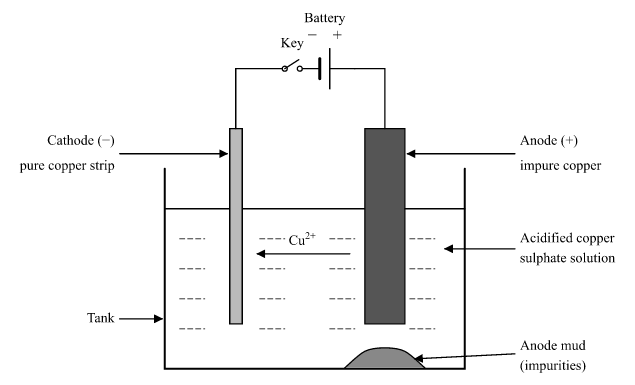 Impure copper is the anode (connected to the positive terminal), a thin strip of pure copper is the cathode (negative terminal) and acidified copper sulphate solution is the electrolyte. Pure copper deposits on the cathode and anode mud collects below the anode.
© examsnet.com
Go to Question: