Test Index
Metals and Non-metals
Metals and Non-metals

 CBSE Board Videos
© examsnet.com
Question : 5 of 47
Marks:
+1,
-0
Show the formation of the following ionic compounds by transfer of electrons between the combining atoms:(i) Sodium oxide ()(ii) Magnesium chloride ()(Given: Atomic number: Na = 11, Mg = 12, O = 8, Cl = 17)
[CBSE 2026 31/3/1]
Solution:
Electronic configurations:Na (11): 2, 8, 1 Mg (12): 2, 8, 2 O (8): 2, 6 Cl (17): 2, 8, 7(i) Sodium oxideEach sodium atom loses its 1 valence electron; the oxygen atom gains 2 electrons to complete its octet. So two Na atoms are needed for one O atom.(ii) Magnesium chlorideThe magnesium atom loses its 2 valence electrons; each chlorine atom gains 1 electron. So one Mg atom gives one electron to each of two Cl atoms.Electron-dot representation (× = electrons of the metal, • = electrons of the non-metal):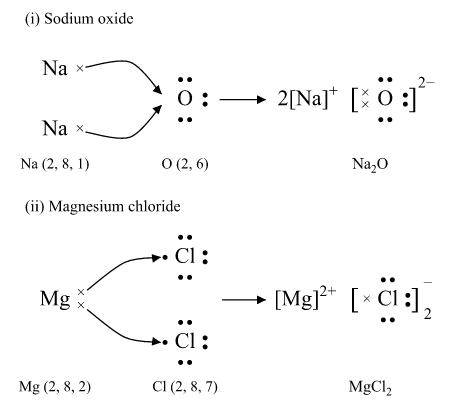 The ions formed (, : 2, 8 and : 2, 8; : 2, 8, 8) all have a complete octet and are held by strong electrostatic forces (ionic bonds).
© examsnet.com
Go to Question: