Test Index
Carbon and its Compounds
Carbon and its Compounds

 CBSE Board Videos
© examsnet.com
Question : 15 of 35
Marks:
+1,
-0
(a) (i) A compound 'X' having two carbon atoms in its molecule turns blue litmus red and 5 – 8% solution of 'X' in water is widely used as a preservative. Identify the compound 'X' and write its structure.(ii) Compare its pH nature with a mineral acid.(iii) 'X' on reacting with alcohols produces sweet smelling compounds, used in making perfumes. Name the reaction and write its chemical equation.(iv) When sodium carbonate is added to 'X', a colourless gas is produced which turns lime water milky. Write the chemical equation for the reaction giving the name of the salt produced.OR(b) (i) Differentiate between saturated and unsaturated hydrocarbons by giving one example each, with a structural formula.(ii) Write the method of converting an unsaturated hydrocarbon into a saturated hydrocarbon. Name the industry where this reaction is commonly used.(iii) Write the name and structure of a hydrocarbon having double bond and four carbon atoms in its one molecule.
[CBSE 2025 31/2/2]
Solution:
(a)(i)A two-carbon compound that turns blue litmus red is an acid, and its 5–8% solution in water is vinegar, used as a preservative in pickles. So 'X' is ethanoic acid (acetic acid), .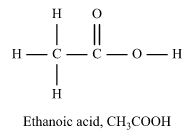 (a)(ii)Ethanoic acid is a weak acid: it ionises only partly in water, so it gives fewer ions than a mineral acid such as of the same concentration. Hence the pH of ethanoic acid is higher than that of a mineral acid (it is less acidic).(a)(iii)The reaction is esterification. A carboxylic acid reacts with an alcohol in the presence of an acid catalyst (a few drops of conc. ) to give a sweet-smelling ester:Ethanoic acid + ethanol ethyl ethanoate (ester) + water.(a)(iv)The salt formed is sodium ethanoate (sodium acetate), .The colourless gas is carbon dioxide; it turns lime water milky by forming insoluble calcium carbonate: .OR (b)(i)
Structural formulae (propane and propene above; the butenes are for part (iii)):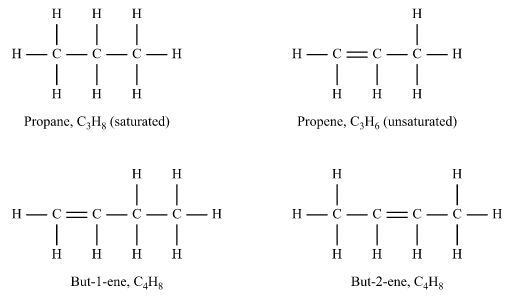 (b)(ii)An unsaturated hydrocarbon is converted into a saturated one by hydrogenation: adding hydrogen in the presence of a catalyst such as nickel (or palladium), with heating. For example, ethene gives ethane:
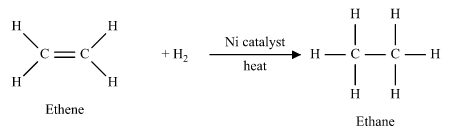 This reaction is commonly used in the vegetable oil (vanaspati ghee) industry, where vegetable oils (unsaturated) are hydrogenated to make solid fats.(b)(iii)A four-carbon hydrocarbon with one double bond is butene, , e.g. but-1-ene, (or but-2-ene, ). Full structural formulae are shown in the figure in part (i).
| Saturated hydrocarbons | Unsaturated hydrocarbons |
| All carbon atoms are joined by single covalent bonds only. | At least one double or triple bond is present between two carbon atoms. |
| General formula (alkanes). | General formula (alkenes) or (alkynes). |
| Generally burn with a clean blue flame. | Generally burn with a yellow, sooty flame. |
| Example: propane, | Example: propene, |
© examsnet.com
Go to Question: