Test Index
Carbon and its Compounds
Carbon and its Compounds

 CBSE Board Videos
© examsnet.com
Question : 14 of 35
Marks:
+1,
-0
(a) Select from the following the members of same homologous series :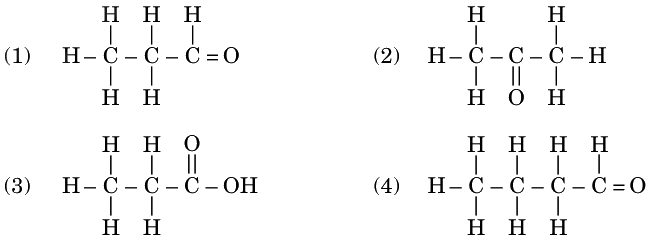 (b) What happens to (i) the melting point, and (ii) the solubility of compounds as the molecular mass of the compounds in a homologous series increases ?
[CBSE 2025 31/2/2]
Solution:
Concept:A homologous series is a family of compounds with the same functional group and similar chemical properties, in which successive members differ by a unit (14 u).(a)(1) , propanal: aldehyde ()(2) , propanone: ketone ()(3) , propanoic acid: carboxylic acid ()(4) , butanal: aldehyde ()Compounds (1) and (4) belong to the same homologous series (aldehydes): both have the group and differ by one unit.(b)(i) The melting point (and boiling point) increases gradually as the molecular mass increases.(ii) The solubility in a particular solvent shows a regular gradation: it generally decreases (in water) as the molecular mass increases.Key point: Physical properties change gradually along a homologous series, but chemical properties stay similar because they depend on the functional group.
© examsnet.com
Go to Question: