© examsnet.com
Question : 29 of 83
Marks: +1, -0
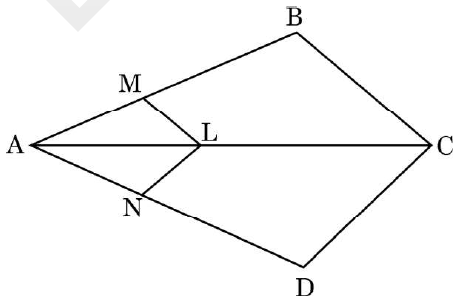
Prove that a line drawn parallel to one side of a triangle to intersect the other two sides in distinct points divides the other two sides in the same ratio. Hence, in the figure given below, prove that AMMB=ANND\dfrac{AM}{MB} = \dfrac{AN}{ND} where LM∥CBLM \parallel CB and LN∥CDLN \parallel CD.
[CBSE 2025 Standard 30/2/2]
Solution:  
Theorem (Basic Proportionality Theorem)
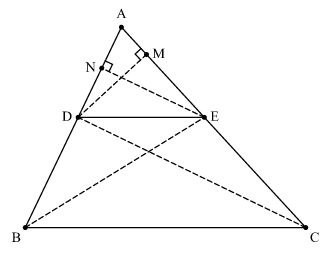
Given: In △ABC\triangle ABC, a line DE∥BCDE \parallel BC meets ABAB at DD and ACAC at EE.
To prove: ADDB=AEEC\dfrac{AD}{DB} = \dfrac{AE}{EC}
Construction: Join BEBE and CDCD. Draw EN⊥ABEN \perp AB and DM⊥ACDM \perp AC.
Proof:
ar(△ADE)=12×AD×EN\text{ar}(\triangle ADE) = \dfrac{1}{2} \times AD \times EN and ar(△BDE)=12×DB×EN\text{ar}(\triangle BDE) = \dfrac{1}{2} \times DB \times EN
∴ar(△ADE)ar(△BDE)=ADDB\therefore \dfrac{\text{ar}(\triangle ADE)}{\text{ar}(\triangle BDE)} = \dfrac{AD}{DB} ...(1)
ar(△ADE)=12×AE×DM\text{ar}(\triangle ADE) = \dfrac{1}{2} \times AE \times DM and ar(△DEC)=12×EC×DM\text{ar}(\triangle DEC) = \dfrac{1}{2} \times EC \times DM
∴ar(△ADE)ar(△DEC)=AEEC\therefore \dfrac{\text{ar}(\triangle ADE)}{\text{ar}(\triangle DEC)} = \dfrac{AE}{EC} ...(2)
△BDE\triangle BDE and △DEC\triangle DEC are on the same base DEDE and between the same parallels DEDE and BCBC, so
ar(△BDE)=ar(△DEC)\text{ar}(\triangle BDE) = \text{ar}(\triangle DEC) ...(3)
From (1), (2) and (3): ADDB=AEEC\dfrac{AD}{DB} = \dfrac{AE}{EC}. Hence proved.
Application
In △ABC\triangle ABC, LM∥CBLM \parallel CB. By the theorem above,
AMMB=ALLC\dfrac{AM}{MB} = \dfrac{AL}{LC} ...(4)
In △ADC\triangle ADC, LN∥CDLN \parallel CD. By the theorem above,
ANND=ALLC\dfrac{AN}{ND} = \dfrac{AL}{LC} ...(5)
From (4) and (5): AMMB=ANND\dfrac{AM}{MB} = \dfrac{AN}{ND}. Hence proved.
© examsnet.com
Advertisements
Go to Question: