Test Index
Triangles
Triangles

 CBSE Board Videos
© examsnet.com
Question : 28 of 83
Marks:
+1,
-0
(a) In the given figure, D is a point on the side BC of such that . Show that .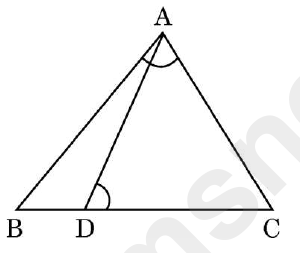 OR(b) In the given figure, . Show that and .
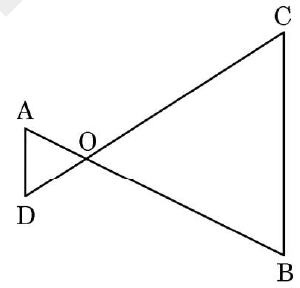
[CBSE 2025 Standard 30/2/2]
Solution:
(a)In and :1. (given)2. (common angle )3. So (AA similarity criterion).4. Corresponding sides of similar triangles are proportional: 5. Cross-multiplying: . Hence proved.Key point: Match the vertices in order: (equal angles at D and A), , .OR (b)1. Given , so .2. In and : (vertically opposite angles).3. The sides including these equal angles are proportional (), so (SAS similarity criterion).4. Corresponding angles of similar triangles are equal: and .5. That is, and . Hence proved.
© examsnet.com
Go to Question: