© examsnet.com
Question : 11 of 83
Marks: +1, -0
(a) State and prove Basic Proportionality Theorem (BPT).
OR
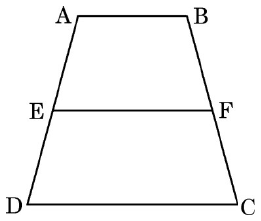
(b) ABCD is a trapezium with AB∥DCAB \parallel DC. E and F are points on non-parallel sides AD and BC respectively such that EF is parallel to AB. Show that AEED=BFFC\dfrac{AE}{ED} = \dfrac{BF}{FC}.
[CBSE 2026 Second Exam Standard 30/7/1]
Solution:  
(a)
Statement: If a line is drawn parallel to one side of a triangle to intersect the other two sides in distinct points, the other two sides are divided in the same ratio.
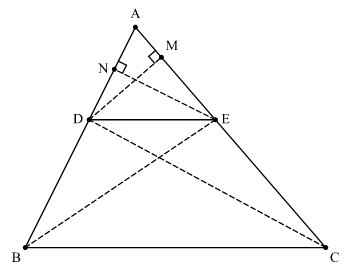
Given: In △ABC\triangle ABC, DE∥BCDE \parallel BC, with DD on ABAB and EE on ACAC.
To prove: ADDB=AEEC\dfrac{AD}{DB} = \dfrac{AE}{EC}
Construction: Join BEBE and CDCD. Draw EN⊥ABEN \perp AB and DM⊥ACDM \perp AC.
Proof:
1. ar(ADE)=12×AD×EN\text{ar}(ADE) = \dfrac{1}{2} \times AD \times EN and ar(BDE)=12×DB×EN\text{ar}(BDE) = \dfrac{1}{2} \times DB \times EN
⇒ar(ADE)ar(BDE)=ADDB\Rightarrow \dfrac{\text{ar}(ADE)}{\text{ar}(BDE)} = \dfrac{AD}{DB} ...(i)
2. ar(ADE)=12×AE×DM\text{ar}(ADE) = \dfrac{1}{2} \times AE \times DM and ar(DEC)=12×EC×DM\text{ar}(DEC) = \dfrac{1}{2} \times EC \times DM
⇒ar(ADE)ar(DEC)=AEEC\Rightarrow \dfrac{\text{ar}(ADE)}{\text{ar}(DEC)} = \dfrac{AE}{EC} ...(ii)
3. △BDE\triangle BDE and △DEC\triangle DEC are on the same base DEDE and between the same parallels DEDE and BCBC, so
ar(BDE)=ar(DEC)\text{ar}(BDE) = \text{ar}(DEC) ...(iii)
4. From (i), (ii) and (iii): ADDB=AEEC\dfrac{AD}{DB} = \dfrac{AE}{EC}. Hence proved.
OR (b)
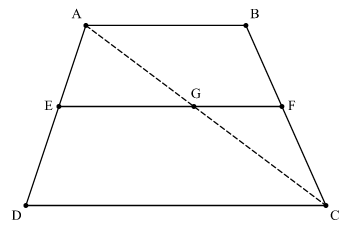
Construction: Join the diagonal ACAC; let it cut EFEF at GG.
Proof:
EF∥ABEF \parallel AB and AB∥DCAB \parallel DC, so EF∥DCEF \parallel DC; hence EG∥DCEG \parallel DC and GF∥ABGF \parallel AB.
1. In △ADC\triangle ADC, EG∥DCEG \parallel DC. By BPT,
AEED=AGGC\dfrac{AE}{ED} = \dfrac{AG}{GC} ...(i)
2. In △CAB\triangle CAB, GF∥ABGF \parallel AB. By BPT,
CGGA=CFFB\dfrac{CG}{GA} = \dfrac{CF}{FB}, i.e. AGGC=BFFC\dfrac{AG}{GC} = \dfrac{BF}{FC} ...(ii)
3. From (i) and (ii): AEED=BFFC\dfrac{AE}{ED} = \dfrac{BF}{FC}. Hence proved.
© examsnet.com
Advertisements
Go to Question: