Test Index
Triangles
Triangles

 CBSE Board Videos
© examsnet.com
Question : 10 of 83
Marks:
+1,
-0
(a) X and Y are points on the sides PQ and PR respectively, of a PQR. If the lengths of PX, QX, PY and YR (in cm) are , , and respectively, then show that XY QR.OR(b) ABCD is a trapezium in which AB DC and P and Q are points on AD and BC respectively, such that PQ DC. If PD cm, BQ cm and QC cm, then find the length of AD.
[CBSE 2026 Second Exam Standard 30/7/1]
Solution:
(a)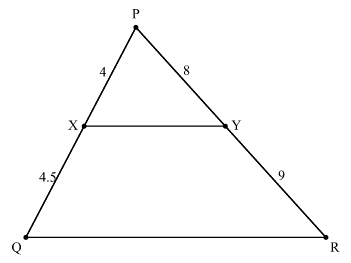 Concept: Converse of the Basic Proportionality Theorem: if a line divides two sides of a triangle in the same ratio, it is parallel to the third side.So , i.e. XY divides PQ and PR in the same ratio.Hence, by the converse of BPT, XY QR. Proved.OR (b)
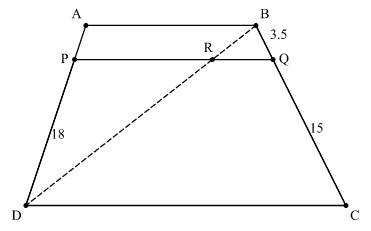 Construction: Join BD, cutting PQ at R.In BDC, RQ DC, so by BPT: ...(i)In DAB, PR AB (since PQ DC AB), so by BPT: ...(ii)From (i) and (ii): cm cmResult: AD cm
© examsnet.com
Go to Question: