Test Index

Some Applications of Trigonometry Get it on Google PlayDownload on the App Store CBSE Board Videos

© examsnet.com
Question : 11 of 42
Marks: +1, -0
(a) The angle of elevation of an airborne helicopter from a point A on the ground is 45∘45^\circ. After a flight of 1515 seconds, the angle of elevation of the helicopter changes to 30∘30^\circ. If the helicopter is flying at a constant height of 20002000 m, find the speed of the helicopter. (Take 3=1.732\sqrt{3} = 1.732)
OR
(b) A girl 1.51.5 m tall is standing at some distance from a 3030 m high tower. The angle of elevation from her eye to the top of the tower increases from 30∘30^\circ to 60∘60^\circ as she walks towards the tower. Find the distance she walked towards the tower.
[CBSE 2025 Standard 30/2/2]
Solution:  
(a)
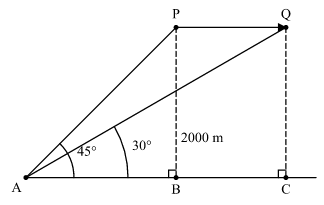
Let PP and QQ be the two positions of the helicopter, and BB, CC the points on the ground vertically below them. PB=QC=2000PB = QC = 2000 m, ∠PAB=45∘\angle PAB = 45^\circ, ∠QAC=30∘\angle QAC = 30^\circ.
In right △ABP\triangle ABP: tan⁡45∘=PBAB⇒1=2000AB⇒AB=2000\tan 45^\circ = \dfrac{PB}{AB} \Rightarrow 1 = \dfrac{2000}{AB} \Rightarrow AB = 2000 m
In right △ACQ\triangle ACQ: tan⁡30∘=QCAC⇒13=2000AC⇒AC=20003\tan 30^\circ = \dfrac{QC}{AC} \Rightarrow \dfrac{1}{\sqrt{3}} = \dfrac{2000}{AC} \Rightarrow AC = 2000\sqrt{3} m
Distance flown PQ=BC=AC−AB=20003−2000=2000(3−1)PQ = BC = AC - AB = 2000\sqrt{3} - 2000 = 2000(\sqrt{3} - 1)
=2000×0.732=1464= 2000 \times 0.732 = 1464 m
Speed =distancetime=146415=97.6 m/s= \dfrac{\text{distance}}{\text{time}} = \dfrac{1464}{15} = 97.6 \text{ m/s}
Result: Speed of the helicopter =97.6 m/s= 97.6 \text{ m/s} (about 351.36351.36 km/h).
OR (b)
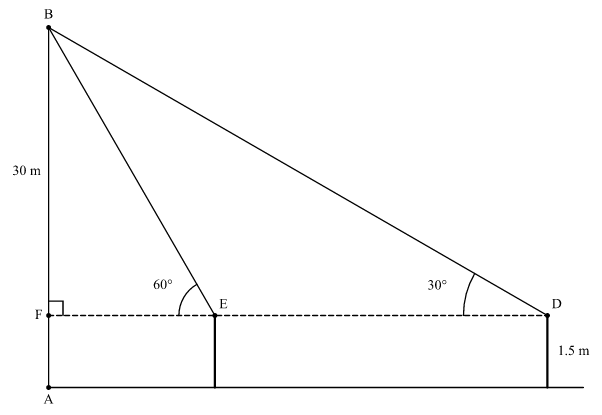
Let ABAB be the tower (AB=30AB = 30 m). The girl's eye is first at DD and then at EE, both 1.51.5 m above the ground. The horizontal line through her eye meets the tower at FF, so AF=1.5AF = 1.5 m and BF=30−1.5=28.5BF = 30 - 1.5 = 28.5 m. ∠BDF=30∘\angle BDF = 30^\circ, ∠BEF=60∘\angle BEF = 60^\circ.
In right △BFE\triangle BFE: tan⁡60∘=BFEF⇒3=28.5EF⇒EF=28.53\tan 60^\circ = \dfrac{BF}{EF} \Rightarrow \sqrt{3} = \dfrac{28.5}{EF} \Rightarrow EF = \dfrac{28.5}{\sqrt{3}} m
In right △BFD\triangle BFD: tan⁡30∘=BFDF⇒13=28.5DF⇒DF=28.53\tan 30^\circ = \dfrac{BF}{DF} \Rightarrow \dfrac{1}{\sqrt{3}} = \dfrac{28.5}{DF} \Rightarrow DF = 28.5\sqrt{3} m
Distance walked DE=DF−EF=28.53−28.53=28.5×3−28.53=573=193DE = DF - EF = 28.5\sqrt{3} - \dfrac{28.5}{\sqrt{3}} = \dfrac{28.5 \times 3 - 28.5}{\sqrt{3}} = \dfrac{57}{\sqrt{3}} = 19\sqrt{3} m
=19×1.732=32.91= 19 \times 1.732 = 32.91 m (approx.)
Key point: Measure the height from the girl's eye level: use 30−1.5=28.530 - 1.5 = 28.5 m, not 3030 m.
Result: She walked 193≈32.9119\sqrt{3} \approx 32.91 m towards the tower.
© examsnet.com
Advertisements
Go to Question: