Test Index
Some Applications of Trigonometry
Some Applications of Trigonometry

 CBSE Board Videos
© examsnet.com
Question : 10 of 42
Marks:
+1,
-0
Case Study – 2A lighthouse stands tall on a cliff by the sea, watching over ships that pass by. One day a ship is seen approaching the shore and from the top of the lighthouse, the angles of depression of the ship are observed to be and as it moves from point P to point Q. The height of the lighthouse is metres.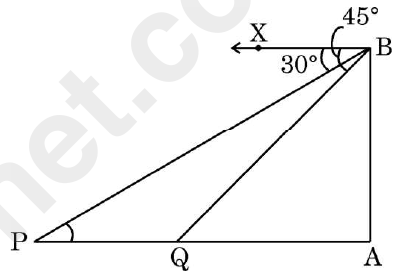 Based on the information given above, answer the following questions:(i) Find the distance of the ship from the base of the lighthouse when it is at point Q, where the angle of depression is . (1)(ii) Find the measures of and . (1)(iii) (a) Find the distance travelled by the ship between points P and Q. (2)OR(b) If the ship continues moving towards the shore and takes minutes to travel from Q to A, calculate the speed of the ship in km/h, from Q to A. (2)
[CBSE 2025 Standard 30/3/1]
Solution:
Concept: The angle of depression from B equals the angle of elevation at the ship (alternate angles, since ). So , , and m with .(i)In right : mResult: The ship is m from the base of the lighthouse at Q.(ii)In : In : Result: , .(iii)(a)In right : m m m (taking )Result: Distance travelled from P to Q m.OR (iii)(b)Distance QA km; time hSpeed km/hResult: Speed of the ship from Q to A km/h.
© examsnet.com
Go to Question: