Test Index
CBSE Class 12 Physics 2016 Delhi Set 1 Paper
© examsnet.com
Question : 21 of 26
Marks:
+1,
-0
(i) State Bohr's quantization condition for defining stationary orbits. How does de Broglie hypothesis explain the stationary orbits? (ii) Find the relation between the three wavelength and from the energy level diagram shown below.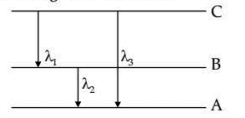
Solution:
(i) Statement of Bohr's quantization condition de- Broglie explanation of stationary orbits (ii) Relation between (i) Only those orbits are stable for which the angular momentum, of revolving electron, is an integral multiple of .[Alternatively i.e. angular momentum of orbiting electron is quantized.] According to de-Broglie hypothesisLinear momentum And for circular orbit where ' ' is the radius of quantized orbits. Also Circumference of permitted orbits are integral multiples of the wave-length . (ii) .......(i) .......(ii) .......(iii) Adding (i) & (ii) ........(iv) Using equation (iii) and (iv)
© examsnet.com
Go to Question: