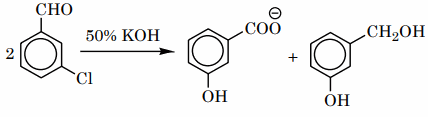
m-Chlorobenzaldehyde does not possess any α-hydrogen atom, so it cannot undergo aldol-type condensation.In the presence of a strong base such as 50%KOH, it undergoes the Cannizzaro reaction, i.e. a base-induced disproportionation (self-oxidation–reduction).In this reaction one molecule of the aldehyde is oxidised to the m-chlorobenzoate ion, while a second molecule of the same aldehyde is reduced to m-chlorobenzyl alcohol.2ClC6H4CHO+KOH50%ClC6H4COO−K++ClC6H4CH2OHMechanism: OH− adds to the carbonyl carbon of one aldehyde molecule to give a tetrahedral intermediate; hydride transfer from this intermediate to the carbonyl carbon of a second aldehyde molecule gives the carboxylate (oxidised product) and an alkoxide, which is protonated to give the alcohol (reduced product).Thus the products formed are potassium m-chlorobenzoate (m-chlorobenzoate ion) and m-chlorobenzyl alcohol.