Test Index
NCERT Class XII Chemistry
NCERT Class XII Chemistry
Chapter - The p-Block Elements
Questions with Solutions
© examsnet.com
Question : 3 of 74
Marks:
+1,
-0
Discuss the trends in chemical reactivity of group 15 elements.
Solution:
Nitrogen has very low reactivity due to unavailability of vacantd-orbital and high bond dissociation energy of N N bond. (a) Hydrides : General formula for hydrides is . All these hydridesarecovalent in nature and have pyramidalstructure (hybridized).
(b) Halides : Elements of group 15 form two types of halides . trihalidesand pentahalides. The halides are predominantly basic (Lewis bases) innature and have lone pair of electrons (central atom is hybridized).The pentahalides arethermallyless stable than the trihalides.
(c) Oxides : All the elements of this group form two types of oxides and and are called trioxides and pentoxides.
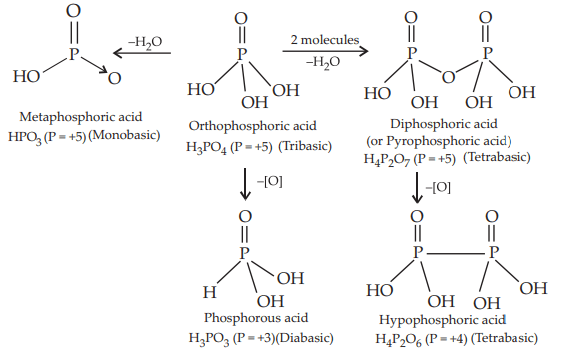
(d) Oxoacids : The elements of this group form a number of oxoacids out of which those of N and P are more common. Oxoacids of N :
| Property | Down thegroup | Reason |
| Basicstrength | decreases | The size of central atom increases, electrondensity decreases. |
| Thermalstability of MH | decreases | The size of the central atom increases,its tendency to form stable M – H bondsdecreases. |
| Reducingcharacter | increases | The stability of hydrides decreases, thus thereducing character increases. |
| Melting andboiling point | increases(except in N) | has high melting point and boilingpoint than due to hydrogen bonding.As the molecular size increases van derWaals forces increases. |
| Property | Gradation | Reason |
| Stability of trihalidesof nitrogen | Large size difference between Nand the halogens | |
| Lewis base strength | Decreasing electronegativity ofhalogens | |
| Bond angle amongthe halides ofphosphorus | Due to decreased bond pair-bondpair repulsion |
| Property | Gradation | Reason |
| Acidic strengthof trioxides | Electronegativity of central atomdecreases | |
| Acidic strengthof pentoxide | Electronegativity of central atomdecreases. | |
| Acidic strengthof oxides ofnitrogen | Oxidation state of central atomincreases | |
| Stability ofpentoxide | Stability of oxides of a higheroxidation state decreaseswith increasing atomic number |
| Formula (Name) | Ox. state of N |
|---|---|
| (Hyponitrous acid) | +1 |
| (Nitrous acid) | +3 |
| (Nitric acid) | +5 |
| Formula (Name) | Ox. state | Basicity |
|---|---|---|
| (Phosphorous acid) | +3 | 2 |
| (Orthophosphoric acid) | +5 | 3 |
| (Metaphosphoric acid) | +5 | 1 |
| (Hypophosphoric acid) | +4 | 4 |
| (Pyrophosphoric acid) | +5 | 4 |
© examsnet.com
Go to Question: