Test Index
NCERT Class XII Chemistry
NCERT Class XII Chemistry
Chapter - Coordination Compounds
Questions with Solutions
© examsnet.com
Question : 15 of 43
Marks:
+1,
-0
Discuss the nature of bonding in the following coordination entities on the basis of valence bond theory : (i) (ii) (iii) (iv)
Solution:
(i) : Fe(26) has electronic configuration . Fe has electronic configuration CN ion causes pairing of electrons because it is a strong field ligand.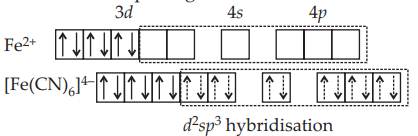 It has octahedral shape and is diamagnetic in nature due to absence of electrons.(ii) : Fe(26) has electronic configuration being a weak field ligand, does not cause pairing of electrons.
 (iii) : Co(27) has electronic configuration . being a strong field ligand causes pairing of electrons.
 (iv) : Co(27) has electronic configuration . being a weak field ligand, cannot cause pairing of electrons.
© examsnet.com
Go to Question: