Test Index
NCERT Class XII Chapter
NCERT Class XII Chapter
Electrostatic Potential and Capacitance
Questions With Solutions
© examsnet.com
Question : 1 of 37
Marks:
+1,
-0
Two charges 5 × C and –3 × C are located 16 cm apart. At what point(s) on the line joining the two charges is the electric potential zero? Take the potential at infinity to be zero.
Solution:
(i) Let C be the point on the line joining the two charges, where electric potential is zero, then = 0 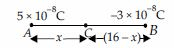 or = 0 or = - or = - or = - or = or 80 – 5x = 3x or 80 = 8x or x = or x = 10 cm So, electric potential is zero at distance of 10 cm from charge of 5 × C on line joining the two charges between them. If point C is not between the two charges, then = 0 or = -
 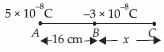 or = - or = - = or 5x = 48 + 3x or 2x = 48 or x = 24 cm So, electric potential is also equal to zero at a distance of 24 cm from charge of C and at a distance of (24 + 16) = 40 cm from charge of 5 × C, on the side of charge of – 3 × C
© examsnet.com
Go to Question: