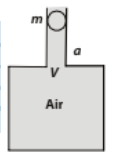
An air chamber of volume V has a neck area of cross section A into which a ball of mass m just fits and can move up and down without any friction as shown in figure. Show that when the ball is pressed down a little and released, it executes SHM. Obtain an expression for the time period of oscillations assuming pressure-volume variations of air to be isothermal
Solution:
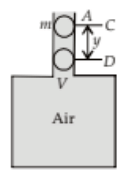
Consider an air chamber of volume V with a long neck of uniform area of cross section A, and a frictionless ball of mass m fitted smoothly in the neck at position C, the pressure of air below the ball inside the chamber is equal to the atmospheric pressure. Increase the pressure on the ball by a little amount P, so that the ball is depressed to position D, where CD = y.There will be decrease in volume and hence increase in pressure of air inside the chamber. The decrease in volume of the air inside the chamber, ΔV A= yVolumetric strain =original volumechange in volume=VΔV=V−Ay∴ Bulk modulus of elasticity B, will beB=volumetric strainstress (or increase in pressure)=AyV−P=Ay−PVHere, negative sign shows that the increase in pressure will decrease the volume of air in the chamber.∴P=V−BAyDue to this excess pressure, the restoring force acting on the ball isF=P×A=V−BAy⋅A=V−BA2yClearly, F∝y, Negative sign shows that the force is directed towards equilibrium position. If the applied increased pressure is removed from the ball, it will start executing linear SHM in the neck of chamber with C as mean position. In SHM, the restoring force, F=−kyComparing (i) and (ii), we havek=VBA2, which is the spring factor.Now, inertia factor = mass of ball =m.As, T=2πspring factorinertia factor =2πVBA2m=A2πBmV∴ Frequency, υ=T1=2πAmVB