Test Index
Oscillations
© examsnet.com
Question : 11 of 25
Marks:
+1,
-0
Figures (a) and (b) correspond to two circular motions. The radius of the circle, the period of revolution, the initial position, and the sense of revolution (i.e. clockwise or anti-clockwise) are indicated on each figure. 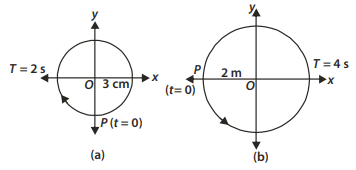 Obtain the corresponding simple harmonic motions of the x-projection of the radius vector of the revolving particle P, in each case.
Solution:
In figure (a) T = 2 s; A = 3 cm At t = 0, OP makes angle with x-axis, i.e. radian. While moving clockwise, here . Thus the x-projection of OP at time t will give us the equation of simple harmonic motion, given by or (where x is in cm) In figure (b) T = 4 s ; A = 2 m At t = 0, OP makes an angle p with the positive direction of x-axis, i.e. . While moving anticlockwise, here . Thus the x-projection of OP at time t will give us the equation of simple harmonic motion given by (where x is in m)
© examsnet.com
Go to Question: