Test Index
Motion in a Plane
© examsnet.com
Question : 6 of 32
Marks:
+1,
-0
Establish the following vector inequalities geometrically or otherwise : (a) (b) (c) (b) When does the equality sign above apply?
Solution:
Consider that the two vectors and are represented by and . The addition of the two vectors i.e. is given by asshown in figure (i) 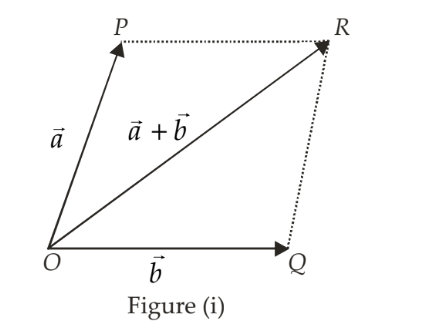 (a) To prove In Figure (i) consider the ΔOQR. Sinceone side of a triangle is always smallerthan the sum of the other two sides, itfollows that OR< QR + OQ or OR < OP + OQ Now, and (i) In case, the vectors and are along the same straight line and point inthe same direction, then (ii) Combining the conditions stated in the equations (i) and (ii), we have (b) To prove In Figure (i) again consider the ΔOQR. It follows that OR + OQ > OR or OR > |QR – OQ| The modulus of QR – OR has been taken for the reason that whereas theL.H.S. is always positive, the R.H.S. may be negative in case QR is smallerthan OQ. Since QR = OP, OR > |OP – OQ| or (iii) In case, the vectors and the same straight line but point in the opposite direction, then (iv) Combining the conditions stated in the equations (iii) and (iv), we have
 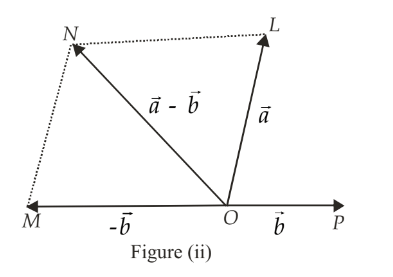 (c) To prove In figure (ii) the vectors and are represented by and respectively. Therefore, the vector is given by From the ΔOMN, it follows that ON < MN + OM or or (v) In case, the vectors and are along the same straight line but point inthe opposite direction, then (vi) Combining the conditions stated in the equations (v) and (vi), we have (d) To prove In figure (ii) again consider the ΔOMN. It follows that ON + OM > MN or ON > |MN – OM| The modulus of MN – OM has been taken for the reason that whereasL.H.S. is positive, R.H.S. may be negative, in case MN is smaller than OM. Since MN = OL, we have ON > |OL – OM| or (vii) In case, the vectors and are along the same straight line and point inthe same direction, then (viii) Combining the conditions stated in equations (vii) and (viii), we have
© examsnet.com
Go to Question: