Test Index

Motion in a Plane

© examsnet.com
Question : 31 of 32
Marks: +1, -0
A cyclist is riding with a speed of 27 kmh127\ \mathrm{km\,h}^{-1}. As he approaches a circular turn on the road of radius 80 m, he applies brakes and reduces his speed at the constant rate of 0.5 ms10.5\ \mathrm{m\,s}^{-1} every second. What is the magnitude and direction of the net acceleration of the cyclist on the circular turn?
Solution:  
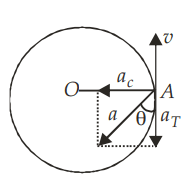
Here, v=27 kmh1=7.5 ms1v=27\ \mathrm{km\,h}^{-1}=7.5\ \mathrm{m\,s}^{-1} ; r=80 mr=80\ \mathrm{m}
Centripetal acceleration, ac=v2r=(7.5)280=0.7 ms2a_c = \frac{v^2}{r} = \frac{(7.5)^2}{80} = 0.7\ \mathrm{m\,s}^{-2}
Suppose that the cyclist applies brakes at the point A of the circular turn. Then, retardation produced dueto the brakes, say aTa_T will act opposite to the velocity, v figure.
Thus, aT=0.5 ms2a_T = -0.5\ \mathrm{m\,s}^{-2}
Therefore, total acceleration is given by
a=ac2+aT2a = \sqrt{a_c^2 + a_T^2} =(0.7)2+(0.5)2= \sqrt{(0.7)^2 + (-0.5)^2} =0.49+0.25=0.74=0.86 ms2= \sqrt{0.49 + 0.25} = \sqrt{0.74} = 0.86\ \mathrm{m\,s}^{-2}
Ifθ is the angle between the total acceleration and the velocity of the cyclist, then tanθ=acaT=0.70.5=1.4\tan \theta = \frac{a_c}{a_T} = \frac{0.7}{0.5} = 1.4 or θ=5428\theta = 54^{\circ} 28'
© examsnet.com
Go to Question: