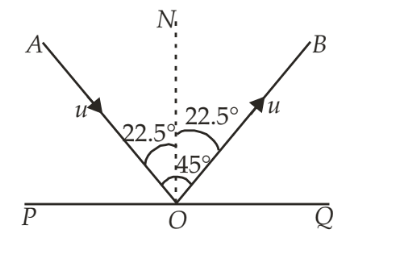
Let the ball of mass
m moving along AO with initial speed
u hits the bat
PQ and is defected by the batsman along
OB (without change in the speed of the ball), such that
∠AOB=45∘ .
Let ON be the normal to the bat such that
∠AON=∠BON=245∘=22.5∘ he initial momentum of the ball can be resolved into the following two components :
(i)
mucos22.5∘ along NO and
(ii)
musin22.5∘ along PQ
Also, the final momentum of the ball can be resolved into the following components :
(i)
mucos22.5∘ along ON and
(ii)
musin22.5∘ along PQ
The component of the momentum of the ball along PQ remains unchanged (both in magnitude and direction). However, the components of the momentum of the ball along ON are equal in magnitude but opposite in direction. Since the impulse imparted by the batsman to the ball is equal to the change in momentum of the ball along ON,
impulse
=mucos22.5∘−(−mucos22.5∘) =2mucos22.5∘Here,
m=0.15 kg ;
u=54 km h−1=15 m s−1Therefore, impulse
=2×0.15×15×cos22.5∘=2×0.15×15×0.9239 =4.16 kg m s−1