Test Index
Laws of Motion
© examsnet.com
Question : 11 of 40
Marks:
+1,
-0
A truck starts from rest and accelerates uniformly at 2.0 m s. At t = 10 s, a stone is dropped by a person standing on the top of the truck (6 m high from the ground). What are (a) velocity, and (b) acceleration of the stone at t = 11 s? (Neglect air resistance.)
Solution:
Initial velocity, Let be the velocity of truck when the stone is dropped from it after t = 10 s. ∴ Using the relation, v = u + at, we get 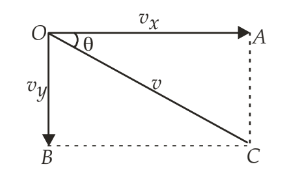 Horizontal velocity of the stone when it is dropped from the truck is As air resistance is neglected, so = constant.Motion in the vertical direction :Initial velocity of the stone, at acceleration, , time sIf be velocity of the stone after 1 s of drop (i.e. at t = 11 s,) thenIf v be the velocity of the stone after 11 s, then Let q be the angle which the resultant velocity OC of the stone makes with the horizontal direction OA i.e. with . Then from ΔOAC,(b) At the moment, the stone is dropped from the truck, the horizontal force on the stone is zero,so, and acceleration along vertical direction which acts in downward direction.∴ If a = resultant acceleration of the stone, then or and it acts vertically downward.
© examsnet.com
Go to Question: