Test Index
Wave Optics
Wave Optics

 CBSE Board Videos
© examsnet.com
Question : 25 of 31
Marks:
+1,
-0
(a) (i) (1) Write two points of difference between an interference pattern and a diffraction pattern.(2) Name any two factors on which the fringe width in a Young's double-slit experiment depends.(ii) In Young's double-slit experiment, the two slits are separated by a distance equal to 100 times the wavelength of light that passes through the slits. Calculate :(1) the angular separation in radians between the central maximum and the adjacent maximum.(2) the distance between these two maxima on a screen 50 cm from the slits.OR(b) (i) A spherical surface of radius of curvature R separates two media of refractive indices and . A point object is placed in front of the surface at distance u in medium of refractive index and its image is formed by the surface at distance v, in the medium of refractive index . Derive a relation between u and v.(ii) A solid glass sphere of radius 6.0 cm has a small air bubble trapped at a distance 3.0 cm from its centre C as shown in the figure. The refractive index of the material of the sphere is 1.5. Find the apparent position of this bubble when seen through the surface of the sphere from an outside point E in air.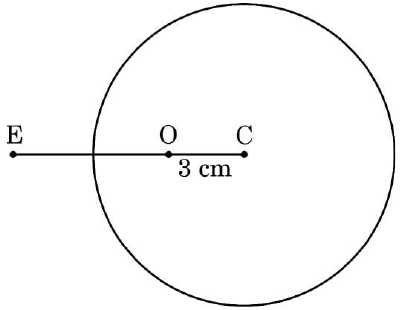
[CBSE 2023 55/1/1]
Solution:
(a)(i)(1) Interference and diffraction patterns (any two):1. In interference the bright fringes are all of (nearly) the same intensity; in diffraction the intensity of the secondary maxima falls rapidly away from the central maximum.2. In interference all fringes have equal width; in diffraction the central maximum is twice as wide as the other maxima.3. Interference is the superposition of two waves from two coherent sources (two slits); diffraction is the superposition of a continuous family of wavelets from different points of the same wavefront (a single slit).4. In interference there is a maximum at angle (slit separation ); in single-slit diffraction the first minimum is at angle (slit width ).(a)(i)(2) Fringe width . It depends on (any two): wavelength of light, distance of the screen from the slits, separation between the slits.(a)(ii) Given: , cm m(1) For the first maximum, , so rad(2) mResult: (1) rad; (2) mmOR (b)(i) Let a convex spherical surface with pole M and centre of curvature C separate media and . A ray from the point object O on the axis strikes the surface at N and is refracted to meet the axis at the image I. NC is the normal at N. Take the aperture small, so all angles are small and is perpendicular to the axis.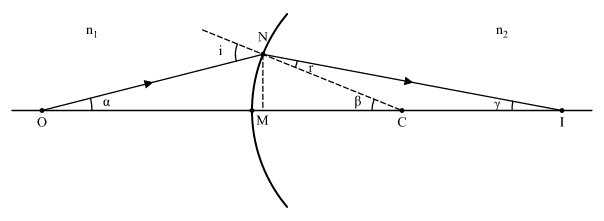 , , In , is the exterior angle: In : Snell's law for small angles: Cartesian sign convention: , , :Result: (b)(ii) Light from the bubble refracts from glass into air at the surface nearer to E. Measure from that point of the surface, with the direction of the light (towards E) positive.Given: (glass), (air); bubble distance from the surface cm, so cm; C is on the glass side, so cm cmResult: The bubble appears cm inside the sphere from the surface (on the same side as the bubble, i.e. cm from the centre C); the image is virtual.
© examsnet.com
Go to Question: